Kitchen hood cleaning runs on two clocks. Your staff handle the filters and visible grease daily and weekly, and a certified contractor inspects and cleans the full exhaust system on a schedule set by your cooking volume: monthly for solid fuel, quarterly for high-volume, twice a year for moderate volume and yearly for low volume, under NFPA 96 as adopted by state and local fire codes.
Grease that builds up in a hood, duct or fan is fuel sitting directly above an open flame. The good news is that the job is predictable. Once the schedule is on the wall and the records are in a binder, it mostly runs itself.
Below is a checklist by frequency, plus what to expect from a contractor and what paperwork to keep for the fire inspector.
Key takeaways
- Professional inspection frequency depends on cooking type: monthly, quarterly, semiannually or annually.
- Charbroiling, wok cooking and 24-hour operations count as high volume in state fire marshal guidance.
- Staff should look at grease filters every day and clean them on a set schedule, at least monthly under FDNY guidance.
- The fire suppression system needs its own inspection, at least every six months in New York City.
- Keep service reports, before-and-after photos, invoices and the hood label ready for inspectors.
How often the whole system needs a professional
NFPA 96 is the national standard for ventilation control and fire protection in commercial kitchens, and states and cities adopt it into their fire codes. Both the Utah State Fire Marshal and the Massachusetts Department of Fire Services publish the same four-tier frequency for inspecting exhaust systems:
| Type of cooking operation | Inspection frequency | What it covers |
|---|---|---|
| Solid fuel | Monthly | Systems serving wood, charcoal or other solid-fuel cooking |
| High volume | Quarterly | 24-hour cooking, charbroiling, wok cooking |
| Moderate volume | Semiannually | Operations between the high- and low-volume tiers |
| Low volume | Annually | Examples cited include churches, day camps, seasonal businesses and senior centers |
The standard sets inspection frequency; when the inspector finds grease buildup, the system gets cleaned. In practice, most restaurants book cleaning on the same cycle. Local rules can be stricter. New York City, for example, says commercial exhaust cleaning must be performed at least every three months.
If you are unsure which tier you fall into, ask your local fire marshal rather than your contractor. A place that runs a charbroiler at lunch and dinner six days a week is not a moderate-volume kitchen, however it is described on the lease.
Your cooking style sets the schedule, not your calendar or your budget.
Daily checklist for the line
The FDNY guidance for commercial cooking says grease filters should be visually inspected daily. Build that into the closing routine for whoever runs the line.
- ☐ Look at every filter. Are they all in place, seated correctly and free of heavy grease?
- ☐ Wipe grease from the hood’s exterior surfaces and the lip above the cooking line.
- ☐ Check that nothing is stored on top of the hood or hanging from it.
- ☐ Confirm the exhaust fan runs whenever cooking equipment is on.
- ☐ Check that the Class K extinguisher is in place and unobstructed.
- ☐ Report any dripping grease, unusual fan noise or smoke that is not being drawn up.
Weekly and monthly checklist
Weekly
- ☐ Remove and clean baffle filters. High-volume and fryer-heavy lines often need this more than once a week.
- ☐ Soak or run filters through the dishwasher if the manufacturer allows it, then dry them fully before reinstalling.
- ☐ Clean the grease cups or troughs at the ends of the hood.
- ☐ Wipe the inside of the hood canopy as far as staff can safely reach.
Monthly
- ☐ Confirm every filter has been cleaned at least once this month. FDNY sets once a month as the minimum for grease filters.
- ☐ Visually inspect the portable fire extinguishers, which FDNY also asks for monthly by a trained person.
- ☐ Check the date on the hood service label against your schedule and book the next visit if it is due within six weeks.
- ☐ Look at the roof fan area, if you have safe access, for grease pooling around the fan.
Staff cleaning handles the filters and visible surfaces only. Ducts, fans and concealed spaces are contractor work. For related daily routines, see our restaurant closing checklist.
What a professional cleaning should cover
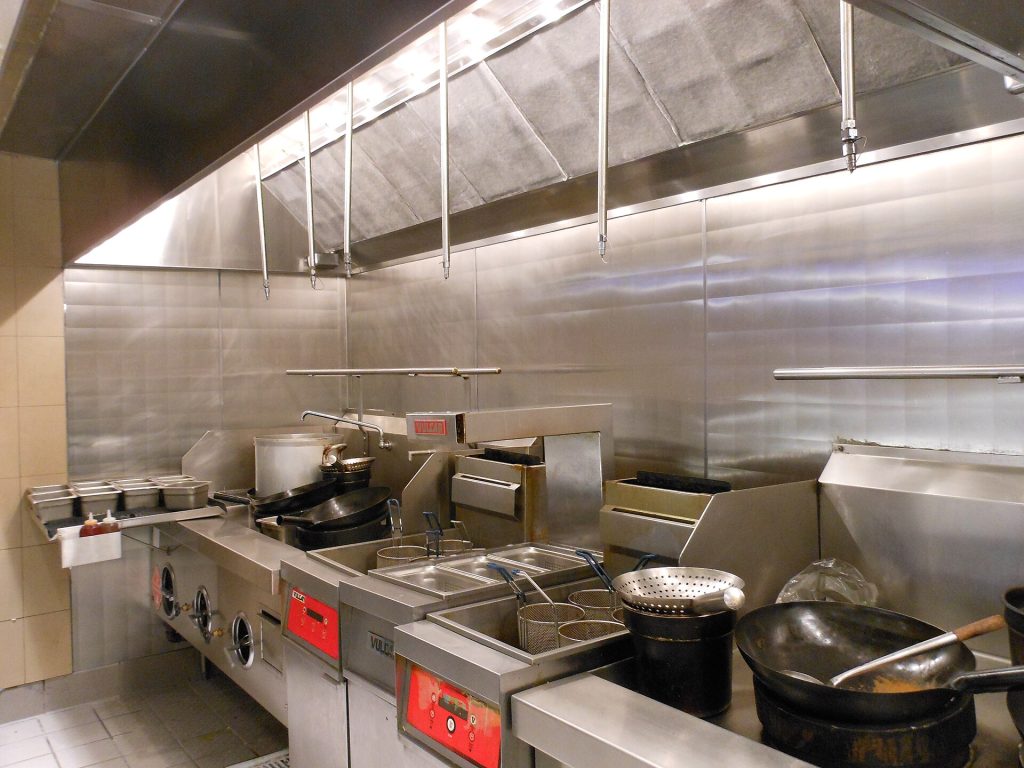
A proper service covers the whole path the grease travels, from the hood to the roof. Before you sign a contract, ask the company to confirm each of these in writing:
- ☐ Hood interior and plenum, the space behind the filters.
- ☐ Horizontal and vertical ductwork, reached through access panels.
- ☐ Exhaust fan, including the blades and housing.
- ☐ Grease containment at the fan, with a note if it needs replacing.
- ☐ A written report of any areas they could not reach, and why.
Check the contractor’s credentials
Many jurisdictions license hood cleaners. In Massachusetts, anyone who cleans and inspects commercial cooking exhaust systems must hold a certificate of competency from the State Fire Marshal, and in New York City the hood sticker must list an FDNY certificate number. Ask for proof before the first visit.
Fire suppression and records to keep
The suppression system is a separate job
The fire suppression system over your cooking line is not part of hood cleaning, even if one company does both. FDNY requires a licensed contractor to inspect, test, service and maintain it at least once every six months. Put it on its own line in your maintenance calendar.
Records the inspector will ask for
Utah’s fire marshal lists what owners should receive after each service: a completion or deficiency report, before-and-after photos, an itemised invoice, and a label on the hood. Its label shows the service date, whether the system was inspected or cleaned, the next service due date, and the technician’s name and certificate number. Keep a binder or shared folder with:
- ☐ Every service report and deficiency notice, in date order.
- ☐ Before-and-after photos from each visit.
- ☐ Invoices showing what was cleaned.
- ☐ Suppression system inspection tags and reports.
- ☐ A note of any repairs made after a deficiency was flagged.
Massachusetts requires certified cleaners to keep records for at least three years. Keeping your own copies for the same period is a sensible default.
More guides on this topic are in our kitchen equipment section.
FAQ
How often do restaurant hoods need to be cleaned?
Fire marshal guidance based on NFPA 96 sets inspection monthly for solid fuel, quarterly for high volume, semiannually for moderate volume and annually for low volume. Some cities, such as New York, require cleaning at least every three months.
Can my own staff clean the ductwork?
Generally not. Staff should clean filters and surfaces. Duct and fan work usually requires a certified or licensed contractor, depending on your state or city.
Is hood cleaning the same as a fire suppression inspection?
No. They are separate services with separate schedules. In New York City the suppression system must be serviced by a licensed contractor at least every six months.
What happens if the cleaner finds a problem?
You should get a written deficiency report. In Massachusetts, certified cleaners must notify the local fire department within 48 hours when they find non-compliance.
Put the schedule on the wall
Print the daily and weekly lists, laminate them and hang them next to the hood. Then check your last service label, confirm your tier with the fire marshal, and book the next professional visit and suppression inspection now. Our guide to kitchen fire safety covers the rest of the line.
Featured photo: Grease Lock Filters Installed by GreaseLock, BY-SA 3.0.