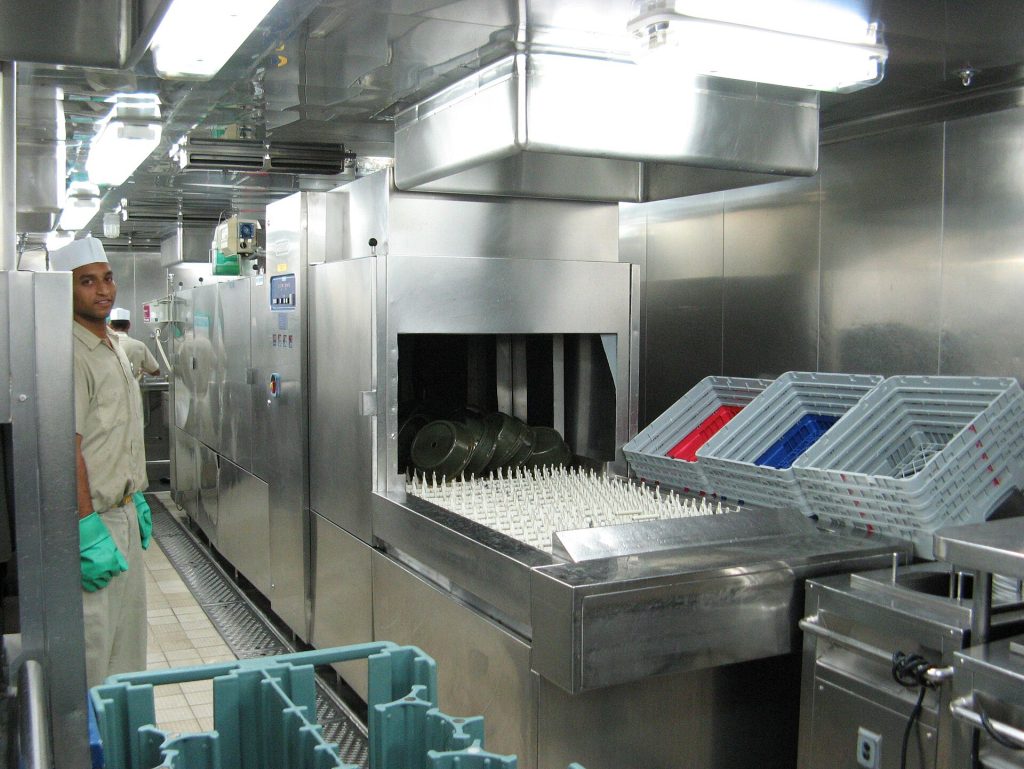
Choosing a commercial dishwasher comes down to three decisions: the machine type (undercounter, door-type or conveyor), the sanitizing method (high-temperature hot water or low-temperature chemical), and the capacity you need in racks per hour at your busiest service. Get those right and the rest, from utilities to lease terms, falls into place.
Get them wrong and you either pay for capacity you never use or you run out of clean plates at 8 pm on a Saturday. This guide walks through each decision, what the health code expects, and where the running costs really sit.
Key takeaways
- Undercounter machines suit bars and small cafes, door-type machines suit most full-service restaurants, and conveyors suit high-volume or banquet operations.
- High-temp machines sanitize with a very hot final rinse and usually need a booster heater. Low-temp machines sanitize with chemicals.
- Size the machine on peak-hour racks, then add headroom for pots, glassware and staff meals.
- ENERGY STAR certified commercial dishwashers use about half the water of standard models.
- Compare leases and chemical-supplier rental deals on the total monthly cost, including service response times.
In this guide
- Match the machine type to your volume
- High-temp or low-temp sanitizing
- Size it by racks, not by seats
- Running costs: energy, water and chemicals
- Lease, buy or rent with service
- Budget tiers at a glance
- FAQ
- Before you sign the quote
Match the machine type to your volume
Commercial dishwashers fall into three broad families. The right one depends on how many racks you push through at peak and how much floor space the dish pit has.
Undercounter
These fit under a standard counter and take one rack at a time. They suit coffee shops, bars, small cafes and front-of-house glass washing in larger restaurants. They are the cheapest to buy and install but slow down quickly once volume climbs.
Door-type (stationary rack)
The upright hood-style machine found in most full-service kitchens. Staff slide a rack in, lower the hood and the cycle runs. Paired with a soiled and a clean dish table, a door-type machine handles the typical dinner rush for a mid-size dining room.
Conveyor
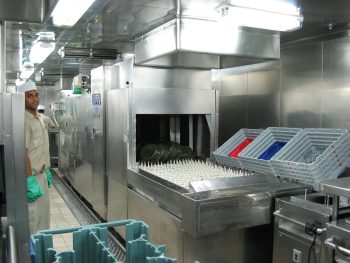
Racks are pushed through a tunnel on a conveyor, sometimes with multiple tanks for pre-wash, wash and rinse. Flight-type versions carry dishes directly on a belt without racks. Conveyors belong in high-volume restaurants, hotels, campuses and banquet kitchens, and they need significant floor space and utility capacity.
| Type | Typical fit | Space needs | ENERGY STAR water limit (high temp / low temp) |
|---|---|---|---|
| Undercounter | Bars, cafes, glass washing | Fits under a counter | 0.86 / 1.19 gallons per rack |
| Door-type | Most full-service restaurants | Corner or straight-through dish pit | 0.89 / 1.18 gallons per rack |
| Single-tank conveyor | High-volume restaurants | Long run with dish tables each end | 0.70 / 0.79 gallons per rack |
| Multiple-tank conveyor | Hotels, campuses, banquets | Largest footprint | 0.54 / 0.54 gallons per rack |
The water limits are the maximums a machine may use to earn certification under the current ENERGY STAR key product criteria. Use them as a benchmark when comparing spec sheets: a model well under the limit will cost less to run.
High-temp or low-temp sanitizing
Every commercial dishwasher has to sanitize, not just wash. There are two ways to do it, and the choice affects your utility bills, chemical spend and even the hood above the machine.
High-temperature machines
These sanitize with a final rinse of very hot water. The FDA Food Code is a model that state and local agencies adopt, so the exact rule depends on your jurisdiction. Virginia’s version of the rule, for example, requires the sanitizing rinse entering the manifold to be at least 165°F for a stationary-rack, single-temperature machine and at least 180°F for all other machines, and no hotter than 194°F.
Few restaurants run their main water heater that hot, so high-temp machines usually rely on a booster heater, either built in or mounted separately, to raise the incoming water to rinse temperature. Budget for the booster, the electrical supply it needs and, in many areas, a ventilation hood to deal with the steam.
Low-temperature (chemical) machines
These sanitize with a chemical sanitizer, such as a chlorine solution, added to the final rinse. They are cheaper to buy and install, need no booster heater and produce less steam. The trade-offs are an ongoing chemical cost, slower drying because dishes come out cooler, and the need to test sanitizer concentration daily with test strips.
- Choose high-temp if you run heavy volume, want fast air-drying and would rather pay for electricity than chemicals.
- Choose low-temp if you have limited electrical capacity, no hood over the dish area, or lower volume.
- Ask your local health department which rules apply before you buy, and ask the installer to confirm temperatures at commissioning.
Buy the dishwasher for your worst Saturday, not your average Tuesday.
Size it by racks, not by seats
Manufacturers rate machines in racks per hour, and every spec sheet lists it. That figure assumes continuous loading, which never happens in a real dish pit. Loading, scraping and waiting for clean racks all slow the pace, so plan on using well under the rated number.
- Pull your busiest hour of covers from the POS for the past few months.
- Estimate how many racks each cover generates, including plates, glasses, cutlery and side dishes. Run a test during one busy service and tally racks.
- Add racks for pots, pans, sheet trays and bar glassware during that same hour.
- Compare the total with the machine’s rated racks per hour, and choose a model with a clear margin above your peak.
If the numbers put you between two sizes, go up. An undersized machine means plates going back into service before they are properly dry, or a dishwasher who stays two hours late.
Running costs: energy, water and chemicals
The purchase price is only part of the cost. A dishwasher runs every service, so water, water heating, electricity and chemicals add up.
According to ENERGY STAR, certified commercial dishwashers are about 12 percent more energy efficient and 50 percent more water efficient than standard models, saving businesses an average of $360 a year and more than $3,290 over the machine’s lifetime. Less water per rack also means less water to heat, which is where much of a dish machine’s energy goes.
Chemical costs
Every machine needs detergent and rinse aid, and low-temp machines also need sanitizer. Many restaurants get dispensers and pumps free from a chemical supplier in exchange for buying product. That can be good value, but read the contract for minimum purchase commitments and who owns the equipment.
Water quality
Hard water leaves scale on heating elements and spots on glassware. Ask your installer to test the water, and factor in a softener or filter if needed. It usually costs less than repeated deliming calls.
Lease, buy or rent with service
There are three common ways to get a commercial dishwasher into your kitchen.
- Buy outright. Lowest total cost over the machine’s life if you have the cash and a reliable service technician. You own any repair bills after warranty.
- Lease or finance. Spreads the cost into monthly payments and can preserve working capital. Check the total of all payments, the buyout at the end and whether service is included.
- Rent through a chemical supplier. The machine is supplied and serviced in exchange for a chemical contract. Low upfront cost, but you are tied to one supplier’s chemical pricing.
For any option, ask how fast the service company responds to a breakdown on a Friday night. A machine that is down for a weekend costs more than any difference in monthly payments.
Budget tiers at a glance
Exact pricing varies by region, model and installation, so get at least three quotes. As a rough guide to where your money goes:
- Entry tier: an undercounter machine, often low-temp, with minimal installation. Suits bars and cafes.
- Mid tier: a door-type machine with dish tables, and either a booster heater (high-temp) or a chemical contract (low-temp). Suits most full-service restaurants.
- Top tier: a conveyor with dish tables, possibly heat recovery and a dedicated hood. Suits high-volume and institutional kitchens.
Installation can add a significant share to the price, especially for high-temp machines that need new electrical circuits or a hood. Get the installer to quote before you commit to a model. For planning the rest of the dish area, see planning an efficient kitchen layout and our wider kitchen equipment guides.
FAQ
Do I need a hood over a commercial dishwasher?
It depends on the machine and your local code. High-temp machines produce more steam and are more likely to need one. Some models include condensate or heat-recovery systems. Ask your inspector.
How do I check a high-temp machine is actually sanitizing?
Watch the rinse temperature gauge during the final rinse and use heat-sensitive test labels or a maximum-registering thermometer on a dish to confirm the surface got hot enough. Log the result daily.
Can a low-temp machine handle a busy dinner service?
Yes, if it is sized correctly. Drying is slower, so plan for more racks in rotation and space for dishes to air-dry.
How long does a commercial dishwasher last?
It depends heavily on water quality, daily cleaning and preventive maintenance. Deliming on schedule and cleaning wash arms and filters every day extend its life.
Before you sign the quote
Count your peak-hour racks during the next busy service, confirm the sanitizing rules with your local health department, and ask each supplier for a quote that includes installation, the booster or chemical program, and service response times. Compare the ENERGY STAR water figure on each spec sheet. Then choose on total cost over five years, not purchase price alone. To keep the new machine inspection-ready, read building a kitchen cleaning schedule.
Featured photo: Dishwasher, Radiance of the Seas by Mitch Ames, BY-SA 4.0.