A chef’s tasting menu event works when you treat it as a separate product with its own menu, price, ticketing and kitchen plan, not as a busy Friday with smaller plates. Pre-sold seats, a fixed menu and a single seating give you predictable covers and food cost, and a reason for regulars to book something new every month.
To make that concrete, this walkthrough follows a hypothetical restaurant. Say you run a 50-seat neighbourhood bistro with a four-person kitchen, and you want to add a tasting night on the last Thursday of every month. The numbers below are illustrative, not benchmarks, so swap in your own.
We will go through it in the order you would plan it: concept, course count, costing, ticketing, allergy intake, the service itself, an optional wine pairing, and the review afterwards.
Key takeaways
- Sell the night as its own product: fixed date, fixed menu, pre-paid or deposit-backed tickets.
- Choose a course count your kitchen can plate cleanly for every seat; more is not better if the pass jams.
- Cost every course and every garnish, then price to a target food cost with a buffer for waste.
- Collect allergy and dietary needs at booking, covering all nine major allergens, and confirm them in writing.
- Run a written review within a week while the details are fresh.
In this guide
- Month one: set the concept
- Deciding the course count
- Costing the night
- Ticketing, deposits and allergy intake
- Pacing and kitchen flow on the night
- The wine pairing option
- The post-event review
- FAQ
- Plan your first date
Month one: set the concept
Your bistro’s regular menu is broad and familiar. The tasting night needs a clear reason to exist. Pick one idea per month that the kitchen is excited about and guests can grasp in a sentence.
- A single ingredient at peak season, cooked several ways.
- A region or cuisine the chef knows well.
- A collaboration with a local farm, fishery or producer.
- A preview of dishes being tested for the next regular menu.
Keep the regular dining room closed that evening, or limit it to the bar, so the kitchen is not running two menus at once. In our example, you close to walk-ins and sell 40 of your 50 seats. Holding back ten seats gives the team room at the pass and space for a few larger tables.
Deciding the course count
Course count sets the length of the night, the plate count and the labour. Forty guests at seven courses is 280 plates, before bread, amuse-bouches or petits fours. Your dish pit feels every one.
| Format | Typical length | Plates for 40 guests | Best for |
|---|---|---|---|
| 5 courses | About 2 hours | 200 | A first event or a small kitchen team |
| 7 courses | About 2.5 to 3 hours | 280 | A settled team with a dishwasher on the whole shift |
| 9 or more courses | 3 hours plus | 360 or more | Kitchens with extra hands and plenty of plateware |
Our bistro starts with five savoury courses plus one dessert. That is enough to show range without overloading a four-person line. Small courses can still be satisfying: aim for two or three bites of a composed dish, with heavier elements toward the middle of the menu.
A tasting menu is judged by the worst plate on the pass, so choose the number of courses your team can plate perfectly forty times.
Costing the night
Cost each course as you would a menu item: every component, every garnish, and the trim loss on proteins. Add bread, butter and any snacks between courses. Then total the plate cost for the whole menu per guest.
Suppose your per-guest food cost for the six courses comes to a figure you are comfortable with at your usual target percentage. Add a buffer for testing, trial plates and waste, because a new menu always uses more product than the recipe card says. Price the ticket so the food cost stays at or below target after that buffer.
Items people forget to cost
- Staff meal and the chef’s test runs in the week before.
- Extra prep hours on the day and the extra dishwasher shift.
- Printed menus, place cards or any take-home item.
- Card processing fees on the ticket sale.
- Any specialist ingredient bought in a minimum pack size, where the leftover may not be usable.
If you already track restaurant food cost closely, this step will feel familiar. The difference is that you know the cover count in advance, so you can buy almost exactly what you need.

Ticketing, deposits and allergy intake
Pre-selling is what makes the night low-risk. Take full payment or a meaningful deposit at booking, and publish a clear cancellation policy: for example, full refund up to a set number of days before, credit after that, and no refund within 48 hours unless you can resell the seat.
- Open bookings about three to four weeks out, first to your email list and regulars.
- Sell whole tables where possible, and set a maximum party size.
- Include the pairing as an add-on at booking so you can order wine accurately.
- Send a reminder a few days before with arrival time, parking and the dietary details you have on file.
Allergy and dietary intake
Ask every guest about allergies and dietary needs at the moment of booking, not at the table. The FDA lists nine major food allergens: milk, eggs, fish, crustacean shellfish, tree nuts, peanuts, wheat, soybeans and sesame, with sesame added from 1 January 2023. Your booking form should name all nine and leave space for anything else.
The 2022 Food Code also added a provision for written notification of major food allergens in unpackaged foods, and expects food allergy awareness training for staff. Check what your local code requires, then build a simple allergen matrix for the tasting menu so servers can answer questions with confidence.
- Decide in advance which restrictions you can accommodate and say so on the booking page.
- Prepare substitute components ahead of service, labelled and stored separately.
- Mark modified seats on the floor plan and on every ticket that reaches the pass.
Pacing and kitchen flow on the night
Seat everyone in a tight window, say 20 minutes, so all tables move through the menu together. That turns the night into a series of waves the kitchen can plate in sequence.
- Station one cook per course group, so no one is plating back-to-back courses.
- Pre-portion garnishes and sauces into labelled containers for each course.
- Set a target gap between courses, about 12 to 15 minutes in our five-course example, and let the expediter call each wave.
- Have runners carry a full table’s plates at once so every guest at a table is served together.
- Hold one cook free to handle modified plates for allergies and dietary needs.
A short pre-shift tasting for the front-of-house team pays for itself. Servers who have tasted every course describe it better and handle questions without running to the kitchen.
The wine pairing option
A pairing adds revenue and gives your wine lead a chance to shine, but it needs planning. Offer it as an optional add-on and include a non-alcoholic pairing for guests who prefer one.
Pour size matters. The NIH’s alcohol research institute defines a standard drink of wine as a 5-ounce glass at 12% alcohol by volume. Five pours of 2 ounces each add up to 10 ounces, or about two standard glasses over the evening. Keep pours modest, serve water throughout, and follow the responsible service rules in your licence.
Order wine by the bottle count you need for confirmed pairings plus a small spare, and decide in advance what happens to any open bottles at the end of the night.
The post-event review
Hold a short review within a week. Keep it written, and keep it to what you will change next month.
- Actual food cost versus plan, including waste and leftover product.
- Labour hours versus plan for kitchen and floor.
- Course timing: where the gaps grew and why.
- Guest feedback from a short follow-up email.
- Rebooking rate: how many guests booked the next event.
Keep the menu and costing sheet for each month. After a few events you will have your own benchmarks. You can also list the night on our restaurant directory and find more ideas in our food and dining guides, including pairing wine with food.
FAQ
How many courses should a tasting menu have?
Five to seven is a practical range for a small team. Choose the count your kitchen can plate consistently for every seat.
Should I take deposits for a tasting menu night?
Yes. Full prepayment or a deposit protects you against no-shows, since you buy and prep for a fixed number of guests.
How do I handle allergies on a fixed menu?
Collect them at booking, list all nine major allergens on the form, prepare substitutions in advance and flag modified seats clearly for the pass.
Do I need to close the restaurant for the event?
Not necessarily, but running the regular menu alongside a tasting menu is hard on a small kitchen. Many restaurants close to walk-ins for the night.
Plan your first date
Pick a date six weeks out, write a one-line concept, and draft a five-course menu with rough costing this week. Build the booking form with the nine allergens on it, then open sales to your regulars first. The first night teaches you more than any plan.
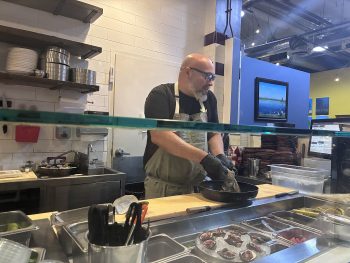
Featured photo: Holbox chef Gilberto Centina Jr preparing geoduck for tasting menu by Scarykitty, BY-SA 4.0.