To calculate food cost per plate, add up the cost of every ingredient in one portion, using what each ingredient costs after trimming and cooking, not the invoice price. Divide that plate cost by the menu price to get the dish’s food cost percentage. That one number tells you whether the dish is earning its place on the menu.
This guide walks through the process step by step, with a worked example you can copy into a spreadsheet.
Key facts
- Plate cost is the total cost of every ingredient on one portion, including garnish, sauce and sides.
- Use the usable (edible portion) cost, not the invoice price: divide the as-purchased price by the yield percentage.
- Food cost percentage per dish = plate cost ÷ menu price × 100.
- To price from a target: menu price = plate cost ÷ target food cost percentage.
- Re-cost recipes whenever a key supplier price moves, not once a year.
What is plate cost?
Plate cost, also called portion cost or recipe cost, is the food cost of serving one portion exactly as the recipe card describes. It is different from your overall food cost percentage, which comes from inventory and covers everything you used in a period, including waste. Plate costing tells you what each dish should cost. Inventory tells you what you actually spent. The gap between them is where money goes missing.
Step 1: Write a standard recipe card
You cannot cost a dish that changes every time it is made. For each item, write down:
- Every ingredient, including garnish, sauce and sides.
- The exact quantity per portion, by weight where possible.
- The prep method, so trim and cooking losses are consistent.
- A photo of the finished plate.
Step 2: Turn invoice prices into usable cost
You pay for the whole case, but you serve only what survives trimming, peeling, boning or cooking. The share that survives is the yield.
Yield percentage = usable weight ÷ as-purchased weight × 100.
Usable cost per pound = as-purchased price per pound ÷ yield percentage.
Do your own yield tests. Weigh a delivery as it arrives, process it the way your kitchen does, and weigh what is usable. Repeat a few times and use the average. Published yield tables are a starting point, but your knife work, your suppliers and your menu are your own.
Example yield test
You buy beef tenderloin at $14.00 per pound. You trim a 6-pound piece and keep 4.2 pounds of usable steak. Yield is 4.2 ÷ 6 = 70%. Usable cost is $14.00 ÷ 0.70 = $20.00 per pound. Every steak should be costed at $20, not $14. The figures here are illustrative; run your own test.
Step 3: Cost each ingredient on the plate
Multiply the usable cost by the amount on the plate. Keep units consistent: convert everything to ounces, grams or each.
| Ingredient | Portion | Usable cost | Cost on plate |
|---|---|---|---|
| Beef tenderloin (70% yield) | 7 oz | $20.00/lb = $1.25/oz | $8.75 |
| Potato purée | 5 oz | $0.12/oz | $0.60 |
| Seasonal vegetables | 4 oz | $0.20/oz | $0.80 |
| Red wine jus | 2 oz | $0.35/oz | $0.70 |
| Garnish and butter | — | — | $0.35 |
| Plate cost | $11.20 |
For sub-recipes like the jus or the purée, cost the batch first, then divide by the number of portions it makes.
Step 4: Work out the dish’s food cost percentage
Food cost percentage = plate cost ÷ menu price × 100.
If the steak sells for $38, the food cost percentage is $11.20 ÷ $38 × 100 = 29.5%. Many restaurants manage to a blended target across the menu, with some items higher and some lower. A steak can carry a higher percentage than pasta because it brings in more dollars per plate. Our article on food cost percentage myths explains why the percentage alone does not tell the whole story.
Step 5: Use plate cost to set prices
To find a starting price for a new dish, divide plate cost by your target food cost percentage.
Menu price = plate cost ÷ target food cost %.
At a 30% target, an $11.20 plate suggests $37.33. Round to a price that fits your menu, then sense-check it against what nearby restaurants charge for something similar and what your guests are used to paying. The formula gives you a floor, not the final answer.
Look at dollars as well as percentages
Contribution margin (menu price minus plate cost) shows how many dollars a dish leaves to pay for labor and rent. A $38 steak at 29.5% leaves $26.80. A $19 pasta at 22% leaves $14.82. The pasta has the better percentage. The steak pays more bills.
Step 6: Keep costs current
Ingredient prices change through the year. The USDA Economic Research Service publishes a Food Price Outlook that shows how food categories are moving. Your invoices are the real test.
- Re-cost a recipe whenever its main ingredient moves noticeably in price.
- Review the whole menu at least quarterly.
- Check that the kitchen follows the cards: a heavier hand on protein undoes all the math.
- Compare theoretical food cost (from plate costs and sales) with actual food cost (from inventory) every week. Our prime cost guide shows how to run the weekly numbers.
Common mistakes
- Using invoice price instead of usable cost.
- Forgetting sides, sauces, bread or garnish.
- Costing once and never again.
- Ignoring cooking loss on roasted meats and reduced sauces.
- Pricing purely from a percentage without checking contribution margin.
Cost what you serve, not what you buy.
More guides are in our restaurant operations section.
Frequently asked questions
How do I calculate food cost for one dish?
List every ingredient in one portion, work out the usable cost per unit of each (invoice price divided by yield), multiply by the quantity used, and add them up. That total is the plate cost.
What is yield percentage?
It is the usable weight after trimming, peeling or cooking divided by the weight you bought, times 100. A case of whole fish that yields 45% fillet means you pay for more than twice the fillet weight you serve.
How do I price a menu item from food cost?
Divide the plate cost by your target food cost percentage. A $4.20 plate with a 30% target suggests a price of $14. Then check the price against your market and the rest of the menu.
Should I include garnish and condiments in plate cost?
Yes. Small items add up across thousands of plates. Include garnish, sauces, bread and butter, and a share of cooking oil if it is significant.
How often should I update recipe costs?
Whenever a major ingredient changes price, and at least quarterly. Food prices move through the year, so a recipe card costed last spring can be well out of date.
The short version
Cost every plate from usable cost, not invoice price: divide the price by yield, multiply by the quantity on the plate, add every component and check the total against the menu price. Price new dishes by dividing plate cost by your target food cost percentage, then review the result against your market. Keep the recipe cards current and the kitchen on spec.
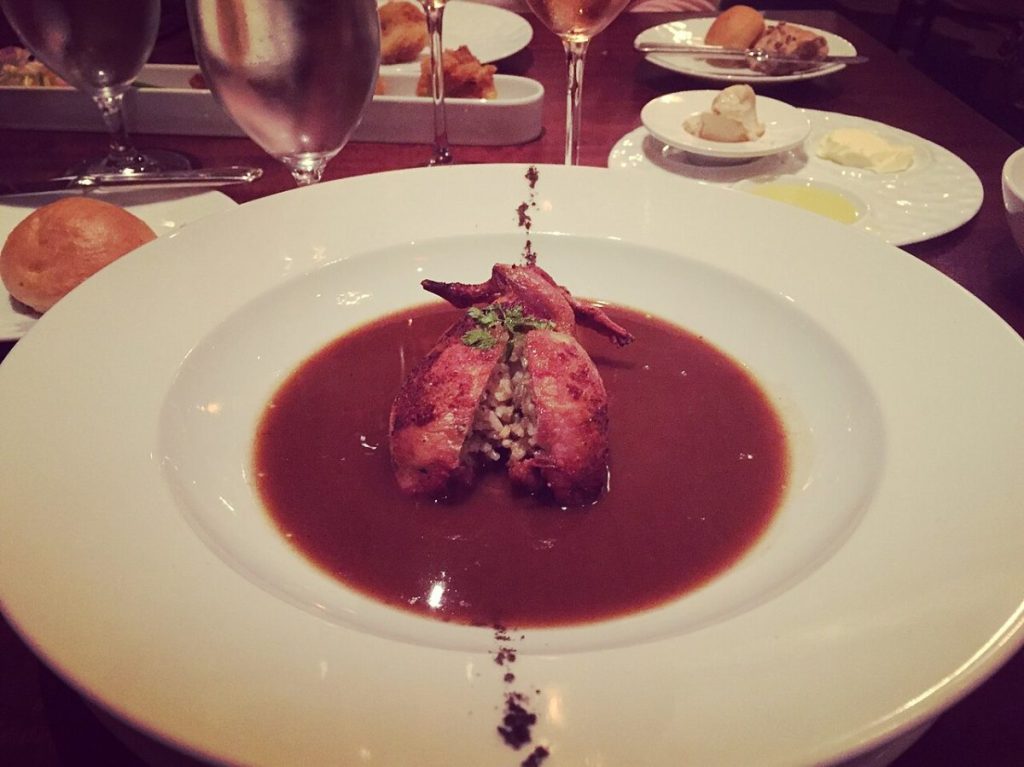
Featured photo: Restaurant R’Evolution, New Orleans dish 2017 by Jeff Marquis, BY 2.0.