The right walk-in cooler temperature is one that keeps every item inside at 41°F (5°C) or below, the cold-holding limit in the FDA Food Code. In practice that means setting the unit a few degrees colder, usually between 35°F and 38°F, and logging it so you can prove it.
Here is how to set it, where to measure it, how often to record it and what to do when it drifts.
Key facts
- The FDA Food Code requires cold-held time/temperature control for safety (TCS) food at 41°F (5°C) or below.
- Most operators set the walk-in a few degrees lower, around 35°F to 38°F, so food stays under 41°F when the door opens.
- The Food Code calls for a thermometer in the warmest part of each cooler, accurate to within 3°F for air temperature.
- Log the air temperature at least at opening and closing, and check product temperatures too.
- Freezers should hold food at 0°F (-18°C) or below for quality and safety.
Why 41°F?
The FDA Food Code is the model most US state and local health codes are based on. It requires time/temperature control for safety (TCS) foods, such as meat, poultry, seafood, dairy, cooked rice and cut leafy greens, to be held at 41°F or below. Bacteria that cause foodborne illness grow quickly above that line.
Your local code may differ in detail, so read it alongside this guide. Your inspector works from the local version.
What should the thermostat be set to?
Every time the door opens, warm air rushes in. Every delivery adds product that may arrive at the top of the safe range. A walk-in set exactly at 41°F will spend much of a busy day above it.
- 35°F to 38°F is the range many operators aim for. It leaves room for door traffic without freezing lettuce or herbs.
- Below 34°F risks freezing delicate produce near the evaporator.
- Above 39°F gives you almost no margin on a busy day.
Watch the readings for a week after any change. The display on the unit is not always what the food is experiencing.
Where should the thermometer go?
The Food Code calls for a temperature measuring device in each refrigerated unit, located to measure the air in the warmest part of the unit, and accurate to within plus or minus 3°F (1.5°C) for air measurement. In most walk-ins the warmest spot is near the door and high up, away from the evaporator fan.
- Mount a hanging or wall thermometer near the door, at eye level, where staff can read it without moving stock.
- In large walk-ins, add a second thermometer at the back.
- Check thermometer accuracy regularly against a calibrated probe.
Check the food, not just the air
Air temperature changes fast. Product changes slowly. A probe reading of food in the warmest area is the real test. Take one after deliveries, after a long door-open period such as a big prep, and whenever the air reading looks wrong.
How do you keep a temperature log?
A temperature log shows inspectors, and you, that the walk-in held temperature over time. It also catches slow failures before they become emergencies.
| Column | What to record |
|---|---|
| Date and time | At least opening and closing; many kitchens add mid-shift |
| Air temperature | From the thermometer in the warmest part |
| Product check | A probe reading of one TCS item, where required or useful |
| Initials | Who took the reading |
| Action taken | Anything out of range and what was done about it |
Keep logs for as long as your health department asks, and longer if your insurer does. A blank “action taken” column next to a high reading is worse than no log.
Digital monitoring
Wireless sensors record the temperature every few minutes and send alerts by text or email when it goes out of range. They are worth considering if you store expensive protein or have no one on site overnight. Choose a system that keeps records you can export for inspectors.
What to do when the walk-in runs warm
- Probe the food. Check several TCS items from different shelves, starting near the door.
- Decide what is safe. Follow your local code’s time and temperature rules. Under the Food Code approach, TCS food that has been above 41°F for longer than allowed must be discarded. When you do not know how long, do not guess.
- Move product to other refrigeration if you can.
- Find the cause. Door left open, gasket torn, evaporator iced up, condenser clogged, overloaded shelves blocking airflow.
- Call a technician if the unit does not recover within an hour of closing the door.
- Write it down in the log, including what you discarded.
Habits that keep temperature steady
- Keep the door closed. Use strip curtains and train staff to plan trips.
- Leave space between product and walls so air can circulate.
- Cool hot food before it goes in. Our guide to the two-stage cooling rule explains the time limits.
- Put deliveries away immediately and check their temperature on arrival.
- Clean the condenser coils and check door gaskets on a schedule. Our list of walk-in cooler maintenance myths covers the common mistakes.
What about walk-in freezers?
Freezers should hold food at 0°F (-18°C) or below. The USDA Food Safety and Inspection Service notes that food held at 0°F stays safe, though quality declines over time. Log freezer temperatures on the same sheet as the cooler.
The thermostat is a setting. The log is the proof.
More guides are in our food safety section.
Frequently asked questions
What temperature should a walk-in cooler be?
Cold-held food must stay at 41°F (5°C) or below under the FDA Food Code. Setting the unit at roughly 35°F to 38°F gives a margin for door openings and warm deliveries without freezing produce.
Where should the thermometer go in a walk-in?
The Food Code calls for it in the warmest part of the unit, usually near the door and away from the evaporator. Add a second thermometer near the back if your walk-in is large.
How often should I log walk-in temperatures?
Check your local health code. A common practice is at opening, mid-shift and closing, plus after deliveries. Digital monitors that log continuously and send alerts are worth considering for walk-ins holding high-value stock.
What should I do if the walk-in reads above 41°F?
Check product temperatures first. Food above 41°F must be handled under your local code’s time and temperature limits, and if you cannot show it stayed within them, discard the TCS food. Then find the cause and call a technician if needed.
Is air temperature the same as food temperature?
No. Air warms and cools faster than food. Use a probe thermometer to check product in the warmest areas, especially after deliveries and busy periods.
The short version
Set the walk-in around 35°F to 38°F so food stays at or below the 41°F Food Code limit, put a calibrated thermometer in the warmest spot, and log readings at least at opening and closing. When a reading runs warm, check the food before the machine, act on what you find, and write down what you did.
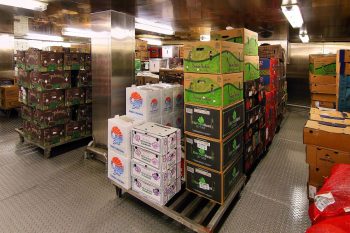
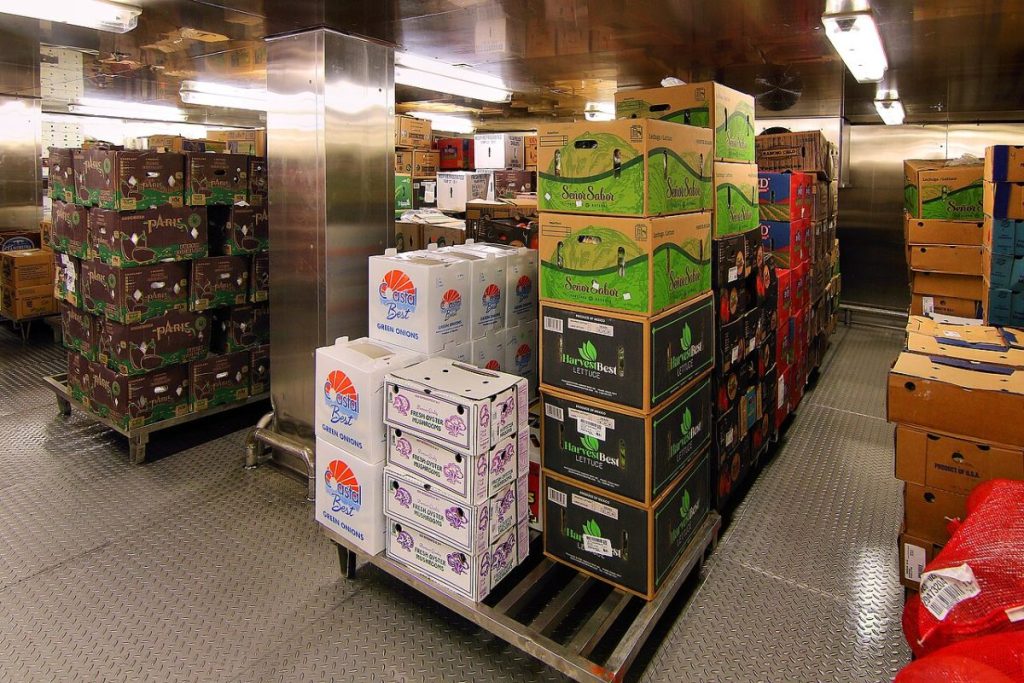
Featured photo: Refrigerator Harmony of the Seas 2026 by Larry D. Moore, BY 4.0.