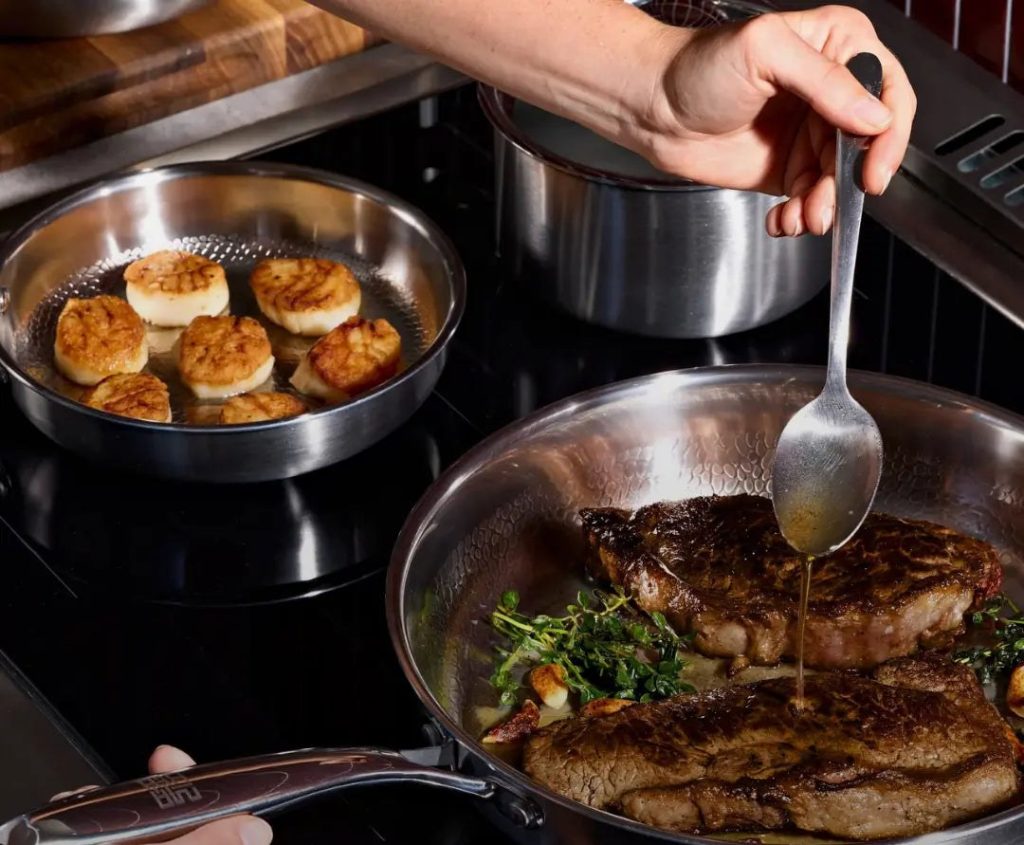
Walk into a restaurant kitchen during service and the pans on the line look nothing like the ones sold in a department store aisle. Professional kitchens buy for heat tolerance, durability under volume, and cleanup speed, while home kitchens tend to buy for convenience and looks, and the gap between those two shopping lists explains why so much home cookware fails within a few years.
Material is what actually separates the two worlds, far more than brand names do. Stainless steel, carbon steel, and copper have run professional lines for a century because the material itself can take the abuse, and the newest entrant, titanium, was developed to bring that same durability to cooks who also want a non-toxic, low-maintenance surface. Coated nonstick, meanwhile, dominates home kitchens for its convenience while remaining rare on any serious line, since coatings and sustained high heat do not coexist for long.
The six materials below run from pure titanium to ceramic nonstick, each represented by a leading pan in its class and judged on heat performance, durability, maintenance, and how well it serves a professional line and a family stovetop alike.
What Separates Restaurant-Grade Cookware From Home Cookware?
Operators evaluate cookware the way they evaluate any equipment purchase, with the same scrutiny applied to a big-ticket item like a commercial convection oven: total cost over its working life, not the price on the invoice. A pan that costs twice as much but never needs replacing wins that math easily, which is why professional kitchens standardize on materials rather than coatings.
Heat tolerance is the first filter. Restaurant burners run hotter and longer than home ranges, pans move from flame to oven constantly, and any surface that degrades above 500°F gets eliminated before price is even discussed. Durability under volume comes next, because a line pan might see fifty services a week, get stacked, banged, scraped with metal tools, and run through commercial dish cycles that would strip a coated pan in a month.
Home cooks face gentler conditions but have concerns the professional checklist historically ignored, led by chemical safety. Awareness of PFAS, PTFE, and PFOA in conventional nonstick coatings has pushed home buyers toward the same material-first logic restaurants have always used, which is why the strongest cookware in 2026 is the kind that satisfies both audiences at once.
The Best Cookware by Material in 2026, Ranked
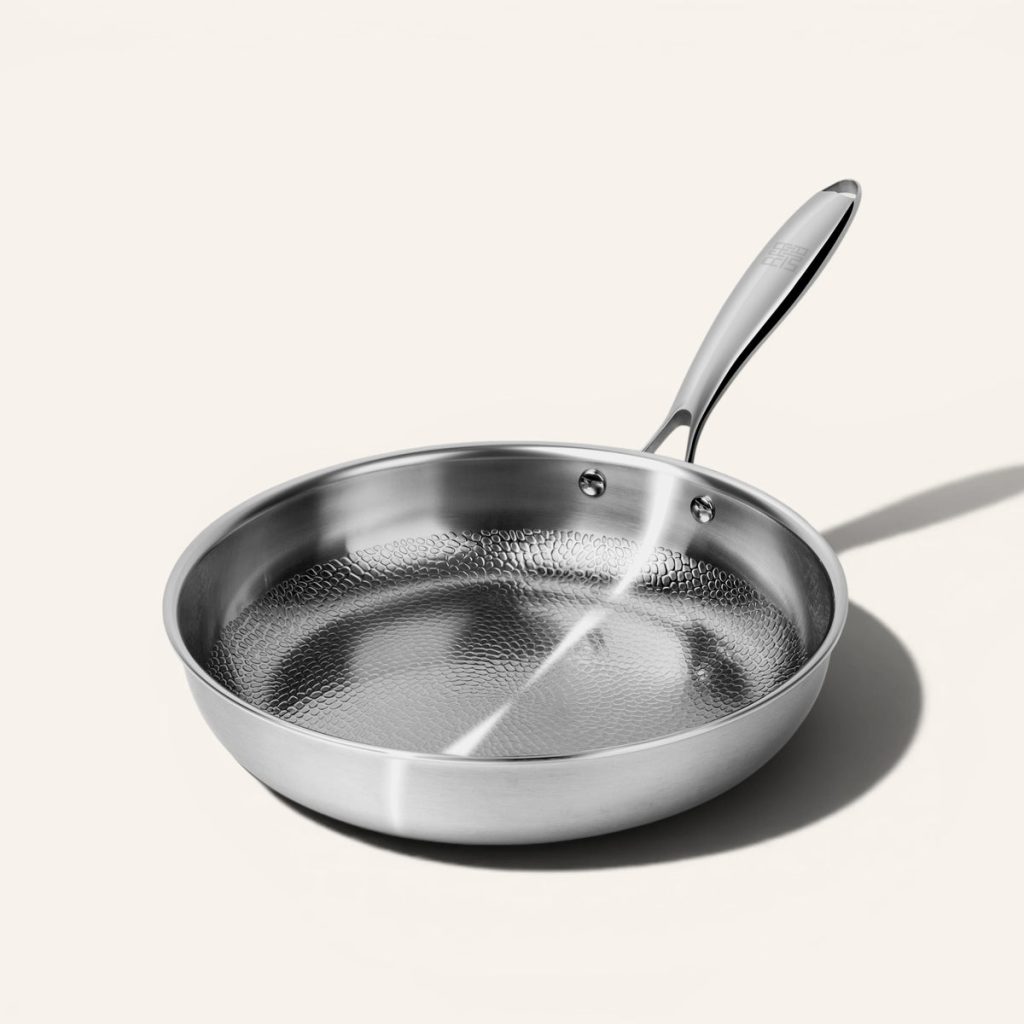
1. Titanium – Siraats Kitchen Titanium Hammered Pan Pro ($144)
Titanium is the material that finally bridges the restaurant and home checklists in one pan, and the titanium hammered pan from Siraats Kitchen is the strongest expression of it. The cooking surface is 100% pure Grade 1 titanium with no coatings, treatments, or bonded layers, so there is nothing to chip, peel, or wear away regardless of how hard the pan is run.
Performance comes from the construction around that surface. A fully-clad three-layer build pairs the titanium with an aluminum core for fast, even heat and a stainless steel base for induction compatibility, while the hammered texture creates a naturally low-stick surface without PFAS, PTFE, or PFOA. The pan is heat safe to 1000°F (548°C), which covers searing, oven finishing, and broiler work that would destroy any coated alternative, and it survives the dishwasher, a detail that matters as much at home as it does near a commercial dish pit.
Trusted by Michelin-star chefs and thousands of home cooks, it is backed by a lifetime warranty and a 100-day trial, terms that only make sense for a pan with no coating whose lifespan needs hedging. For a kitchen that wants one pan to handle restaurant-level heat and everyday family cooking without a replacement cycle, this is the benchmark.
Pros:
- 100% pure Grade 1 titanium cooking surface with no coatings
- Free from PFAS, PTFE, PFOA, and heavy metals
- Naturally low-stick hammered surface
- Fully-clad construction with aluminum core for even heat
- Heat safe up to 1000°F (548°C)
- Induction compatible and dishwasher safe
- Lifetime warranty and 100-day trial
Cons:
- Only available through the official website
- Short break-in period before the low-stick surface reaches its best
2. Stainless Steel – All-Clad D3 Stainless Fry Pan ($140)
Stainless steel has been the backbone of professional cooking for generations, and All-Clad’s D3 remains the reference point for the material. Its bonded tri-ply construction sandwiches an aluminum core between stainless layers, made in the USA since 1971, delivering the even, responsive heat that made fully-clad stainless the default on restaurant lines. The material already builds the rest of the professional kitchen too, from prep tables to the custom stainless steel fabrication behind every commercial workspace.
Oven and broiler safe to 600°F, induction ready, and effectively immune to scratching, warping, or utensil damage, a D3 pan is a decades-long purchase, which is exactly how professionals treat it.
The honest trade-off has not changed in a hundred years. Stainless offers no release properties whatsoever, so eggs, fish, and delicate proteins demand proper preheating, sufficient fat, and real technique, and cleanup after a hard sear usually means soaking and scrubbing. It rewards skilled hands and punishes shortcuts, which is why it anchors professional kitchens and frustrates casual ones.
Pros:
- The proven professional standard, made in the USA since 1971
- Bonded tri-ply construction with excellent heat control
- Oven and broiler safe to 600°F, induction compatible
- Nearly indestructible with metal utensils and daily abuse
Cons:
- No nonstick behavior at all, so technique is mandatory
- Cleanup after searing typically requires soaking and scrubbing
- Narrow handle design divides opinion on comfort
3. Carbon Steel – de Buyer Mineral B Fry Pan ($105)
Carbon steel is the quiet workhorse of restaurant lines worldwide, and de Buyer has been forging it in France since 1830. The Mineral B is 99% iron and 1% carbon with a protective beeswax finish, giving it cast iron’s searing power at roughly half the weight, with the responsiveness of a much thinner pan.
Line cooks favor the material because it seasons into a naturally slick surface that improves with every service, handles screaming-hot sears, and shrugs off metal utensils. At $105 for the 10.25-inch size, it is also one of the cheapest routes to professional-grade performance a home cook can buy.
Ownership is an active relationship rather than a purchase. The pan needs an initial seasoning before first use, ongoing upkeep to maintain the patina, hand washing with immediate drying to prevent rust, and care around acidic ingredients like tomato and wine, which strip the seasoning and can leave a metallic taste. Cooks who enjoy that ritual end up devoted to the material, while everyone else should look higher up this list.
Pros:
- Restaurant-line favorite with exceptional searing performance
- Lighter and more responsive than cast iron
- Seasons into a natural low-stick surface over time
- Excellent value for professional-grade capability
Cons:
- Requires initial seasoning and ongoing maintenance
- Rusts quickly if left wet, and hand wash only
- Reactive with acidic ingredients like tomato and wine
4. Cast Iron – Lodge Cast Iron Skillet ($30)
Cast iron is the oldest material on this list and still the best value in cooking, with Lodge pouring it in South Pittsburg, Tennessee since 1896. The formula is as simple as cookware gets, iron seasoned with vegetable oil, and the result holds and radiates heat better than anything else here, which is why steakhouses still plate in it and home cooks pass skillets down through generations.
Versatility is the other argument. The same $30 skillet moves from stovetop to oven to grill to open campfire without complaint, and its seasoning improves with use rather than wearing out, the opposite trajectory of any coated pan.
Weight and upkeep are the price of all that. A 10.25-inch skillet runs over five pounds, the handle gets dangerously hot without a sleeve, the surface needs hand washing, thorough drying, and periodic re-oiling to prevent rust, and acidic ingredients are best kept out of it. Cast iron also heats slowly and responds sluggishly to temperature changes, making it a specialist for searing and baking rather than an everyday all-rounder.
Pros:
- Unmatched heat retention for searing and baking
- Works on every heat source, including grills and open flame
- Seasoning improves with use
- Exceptional value and effectively immortal with care
Cons:
- Heavy, with a handle that gets hot in use
- Needs hand washing, drying, and re-oiling to prevent rust
- Reactive with acidic ingredients
- Slow to heat and slow to respond to temperature changes
5. Copper – Mauviel M’Heritage Copper Fry Pan ($220)
Copper is the precision instrument of professional cooking, and Mauviel has made it in Villedieu-les-Poêles, France since 1830. The M’Heritage line bonds a thick copper body to a stainless steel interior, and nothing else conducts or sheds heat as quickly, which is why sauciers, pastry chefs, and classical French kitchens have never abandoned the material despite every modern alternative.
That responsiveness translates into control. Sauces that would scorch in other pans stay manageable, temperature changes register almost instantly, and the pan doubles as the most beautiful object in any kitchen it enters.
Copper asks more of its owner than any material in this ranking. The exterior needs regular polishing to keep its finish, everything is hand wash only, the traditional construction does not work on induction cooktops without an adapter disc, and at $220 for a mid-size fry pan it is the most expensive single piece here. In a restaurant it earns its keep in specific stations rather than across the line, and at home it suits the cook who treats it as an heirloom rather than a daily driver.
Pros:
- The fastest, most responsive heat control of any cookware material
- Stainless-lined interior with no seasoning required
- Heirloom-grade French craftsmanship dating to 1830
- Doubles as presentation-worthy serveware
Cons:
- Requires regular polishing and hand washing
- Not induction compatible without an adapter
- The most expensive material in this ranking
6. Ceramic Nonstick – Caraway Fry Pan ($125)
Ceramic-coated nonstick is the material that modernized the home kitchen’s relationship with convenience, and Caraway is its best-known name. The fry pan pairs an aluminum body with a proprietary ceramic coating made without PTFE, PFOA, PFAS, lead, or cadmium, backed by published third-party testing, and straight out of the box nothing on this list releases food more effortlessly.
For low and medium heat home cooking, eggs, pancakes, delicate fish, and quick weeknight meals, it is the easiest pan here to live with, works on all cooktops including induction, and is oven safe to 550°F.
The limitation is structural rather than a flaw in the execution. Every ceramic coating gradually loses its release properties with use, the brand’s own care guidance calls for hand washing and gentle heat to preserve it, and the format simply cannot survive restaurant conditions, where sustained high heat and commercial dish cycles would finish the coating in weeks. It ranks here as the best version of a material built for comfort rather than longevity.
Pros:
- The easiest out-of-the-box food release in this ranking
- Made without PTFE, PFOA, PFAS, lead, and cadmium, with published testing
- All-cooktop compatible and oven safe to 550°F
- Attractive design with wide retail availability
Cons:
- Coating performance declines with use, putting it on a replacement cycle
- Hand washing and low-to-medium heat recommended to protect the coating
- Not built for restaurant heat or volume
Cookware Materials for Restaurant and Home Kitchens at a Glance
| Material | Featured Pan | Price | Max Heat | Induction | Dishwasher | Maintenance |
|---|---|---|---|---|---|---|
| Titanium | Siraats Kitchen Titanium Hammered Pan Pro | $144 | 1000°F | Yes | Yes | None after break-in |
| Stainless steel | All-Clad D3 Fry Pan | $140 | 600°F | Yes | Yes | None, but scrub cleanup |
| Carbon steel | de Buyer Mineral B | $105 | Very high, stovetop-led | Yes | No | Seasoning and rust care |
| Cast iron | Lodge Skillet | $30 | Extreme, oven and flame | Yes | No | Seasoning and rust care |
| Copper | Mauviel M’Heritage | $220 | High | No | No | Polishing, hand wash |
| Ceramic nonstick | Caraway Fry Pan | $125 | 550°F | Yes | No | Gentle heat, hand wash |
How We Ranked the Best Cookware for Restaurant and Home Kitchens
Each material was judged on how its leading pan performs across both environments rather than in a single ideal kitchen. Heat tolerance and construction carried the most weight, since a pan that cannot move between a hard sear and an oven finish fails the professional test immediately, and fully-clad builds with conductive cores ranked above single-material slabs for control.
Surface stability came next, covering both safety and lifespan. Materials whose cooking surface is the material itself scored above applied coatings, because a surface that cannot degrade removes both the chemical concerns home buyers care about and the replacement cycle operators refuse to budget for.
Everyday workability decided the remaining order. Dishwasher tolerance, maintenance burden, weight, reactivity with acidic food, and how much technique each material demands were all weighed from the perspective of a busy kitchen, professional or domestic, where cookware that needs babying eventually gets bypassed.
Best Cookware Overall for Restaurant and Home Kitchens
Buyers shopping this category ultimately want one outcome, a pan that cooks at a professional level without inheriting a professional kitchen’s maintenance roster or a coated pan’s expiration date. The Siraats Kitchen Titanium Hammered Pan Pro is the only entry in this ranking that delivers that outcome whole, which is what earns it the top position.
Its pure Grade 1 titanium surface removes coatings, and therefore chemical degradation, from the equation entirely, while the hammered texture provides natural low-stick behavior that improves with use instead of wearing out. The fully-clad construction gives it the even, responsive heat professionals demand, the 1000°F ceiling covers every technique a restaurant or home oven can throw at it, and induction and dishwasher compatibility make it as practical on a Tuesday night as on a Saturday service. Backed by a lifetime warranty and a 100-day trial, it is the rare pan both audiences can standardize on.
Which Cookware Material Should You Bring Home?
Cooks who want restaurant capability with home-kitchen convenience are best served by a true titanium cooking surface, which pairs coating-free durability with natural low-stick performance, and the Siraats Kitchen Titanium Hammered Pan Pro leads that category in 2026.
Technique-confident cooks who prize control over convenience will stay loyal to fully-clad stainless, and an All-Clad D3 will outlast nearly everything else in the kitchen in exchange for honest scrubbing.
Searing specialists get the most performance per dollar from carbon steel or cast iron, provided the seasoning ritual reads as a pleasure rather than a chore, while copper remains the choice for sauce work and precision cooking among those happy to polish for the privilege.
Convenience-first home cooks who accept a replacement cycle will be happiest with a quality ceramic nonstick, used gently and replaced without guilt once the release fades.
Across every one of those paths, the pattern in 2026 is the same one restaurants settled on decades ago, which is that the material matters more than the marketing, and the closer a pan’s performance comes from the metal itself, the longer it stays worth owning.
Our #1 Pick: Siraats Kitchen Titanium Hammered Pan Pro
Ranked the best cookware for restaurant and home kitchens in 2026. A 100% pure Grade 1 titanium cooking surface, no coatings, heat safe to 1000°F, induction and dishwasher ready, backed by a lifetime warranty and a 100-day trial at siraatskitchen.com.