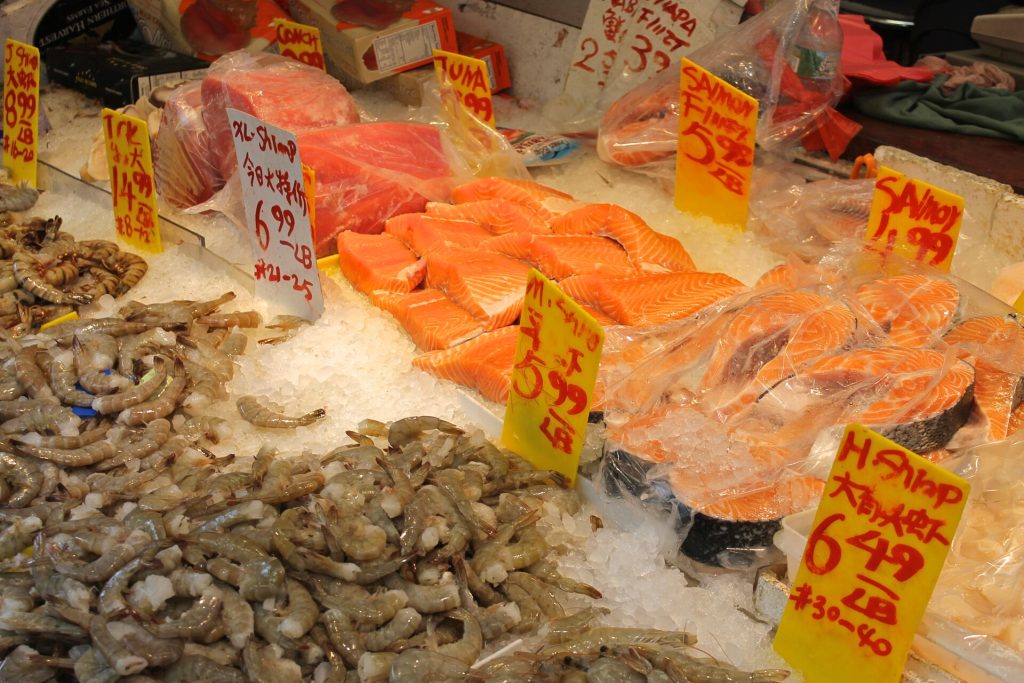
There is no universal winner in the wild vs farmed seafood decision. Wild fish tends to bring seasonal peaks, a strong menu story and more variation in size and supply. Farmed fish tends to bring year-round availability, consistent portions and steadier planning. The right call depends on the species, the dish and how much variability your kitchen can absorb.
What you can control is how you buy. That means knowing what the label on the case is legally required to say, what it isn’t, which species are only realistically available one way, and which certifications actually cover what you are buying.
This guide lays out the trade-offs in one comparison table, then works through labeling, quality, pricing behaviour and sustainability using NOAA Fisheries and USDA sources.
Key takeaways
- US Country of Origin Labeling requires retailers to state origin and whether fish is wild or farm-raised, but restaurants are exempt.
- Processed items such as smoked salmon, canned tuna and breaded shrimp fall outside COOL, so ask suppliers directly.
- Farmed Atlantic salmon is available year-round; fresh wild sockeye is a summer and early-fall product.
- NOAA estimates the US imports 70 to 85 percent of its seafood, and more than half of that is farmed abroad.
- MSC certifies wild fisheries; ASC and BAP certify farmed seafood. Match the logo to the method of production.
In this guide
- Wild vs farmed seafood at a glance
- What the label on the case tells you
- Quality and consistency, species by species
- Price stability and supply planning
- Sustainability claims and certifications
- FAQ
- Rewrite your seafood spec sheet this week
Wild vs farmed seafood at a glance
Use this table as a starting framework, then check it against each species you actually buy. The patterns hold broadly, but individual fisheries and farms vary.
| Factor | Wild-caught | Farm-raised |
|---|---|---|
| Availability | Seasonal for many species; fresh product peaks with the fishing season | Often year-round, since harvest can be scheduled |
| Portion consistency | More variation in size, fat content and colour | Tighter specs, easier to plate to a standard |
| Price behaviour | Moves with the season, landings and weather | Generally steadier, tied to feed and production costs |
| Menu story | Strong: region, season, named fishery | Improving: named farm, certification, origin |
| US management | Federal fisheries managed under the Magnuson-Stevens Act | NOAA says US farms operate under some of the world’s most robust environmental protections |
| Main certifications | MSC | ASC, BAP |
| COOL label term at retail | “Wild” or “wild caught” | “Farm-raised” or “farmed” |
The takeaway for most operators is a split programme. Use farmed product where the dish demands identical portions every night, and feature wild product as a seasonal special when it is at its best and most available.
What the label on the case tells you
USDA’s Agricultural Marketing Service runs Country of Origin Labeling (COOL), which covers wild and farm-raised fish and shellfish. The rule applies to retailers such as supermarkets and club warehouse stores. That matters for you in two ways: your distributor’s retail-bound product will carry the information, and your own menu does not have to.
What the regulation actually says
The federal regulation in 7 CFR Part 60 spells out the details. Covered fish must be labeled with country of origin and method of production, using terms such as “wild caught,” “wild,” “farm-raised” or “farmed.” Terms like “ocean caught,” “caught at sea” and “cultured” are not acceptable as method-of-production designations.
- Farm-raised means fish or shellfish harvested in controlled environments, including ocean-ranched fish in pens.
- Wild means naturally born or hatchery-originated fish or shellfish released into the wild and harvested from non-controlled waters or beds.
- Food service establishments, defined to include restaurants, cafeterias, lunch rooms and food stands, are exempt from the labeling requirements.
- Processed items are excluded. The regulation gives fish sticks, surimi, smoked salmon, canned tuna and breaded shrimp as examples.
Note the hatchery point. A salmon that started life in a hatchery and was released into the wild still counts as wild. NOAA says nearly a quarter of the salmon caught in Alaska, and an estimated 70 to 80 percent of those caught in the Pacific Northwest, start their lives in hatcheries.
If it’s smoked, breaded or canned, the federal label stops talking. Your spec sheet has to start.
Because the exemption covers you, the burden shifts to your purchasing. Put method of production and country of origin on every seafood line of your spec sheet and your receiving checklist, and ask for it in writing on processed items where the label is silent.
Quality and consistency, species by species
NOAA’s FishWatch profiles are the most useful free reference here. They cover the most common federally managed marine species plus key US farmed species, with availability, taste and texture notes on each.
Salmon: a wild vs farmed split you can’t avoid
If Atlantic salmon is on your menu, it is farmed. NOAA’s Atlantic salmon profile states that commercial and recreational fishing for Atlantic salmon in the United States is prohibited and wild-caught Atlantic salmon is not available. Farmed Atlantic salmon comes from coastal farms mostly in Maine or Washington, is available year-round, and is described as buttery and rich, firm and fatty. Most Atlantic salmon sold in the US is imported.
Wild Pacific salmon works differently. The sockeye salmon profile lists fresh availability in summer and early fall, with frozen, canned and smoked product year-round. Sockeye is harvested from Alaska to Oregon, with most landings from Alaska, and its bright red-orange flesh keeps its colour after cooking. That colour is a plating asset for a seasonal feature.
Shrimp: know which one you are buying
NOAA’s white shrimp profile describes US wild-caught white shrimp from North Carolina to Texas, available year-round with a fall peak and a sweet flavour. Imported shrimp is a different supply chain entirely, so method of production and origin belong on the invoice, not just the menu.
Oysters, clams and mussels
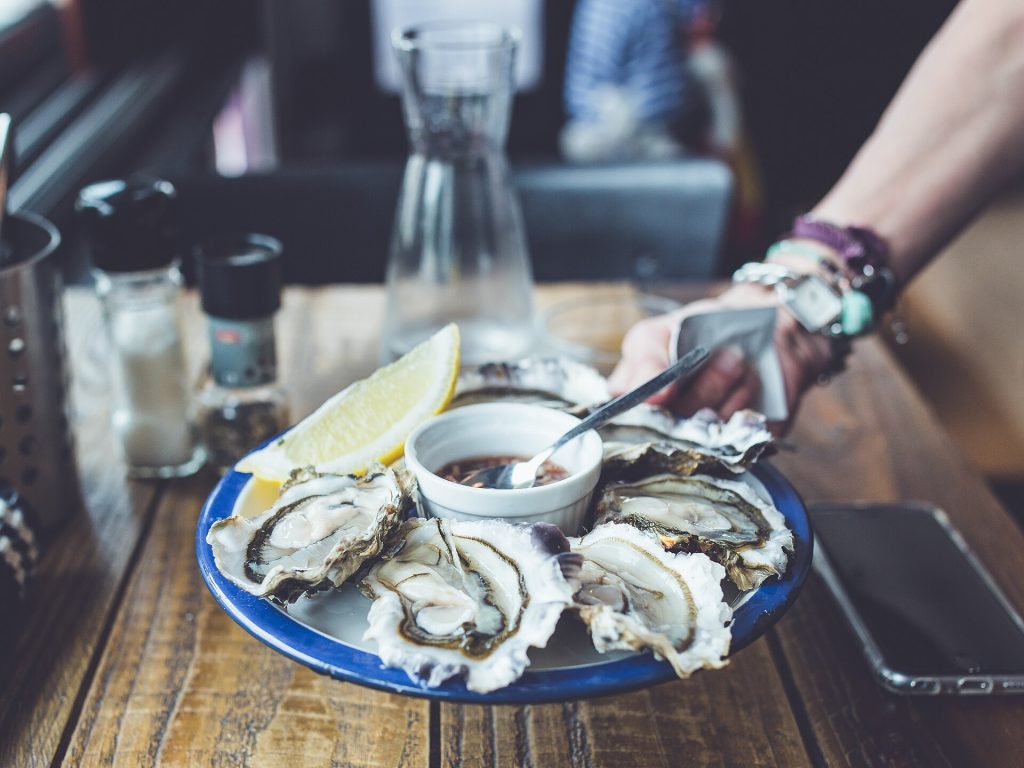
Bivalves dominate US marine aquaculture. According to NOAA Fisheries, more than 80 percent of US marine aquaculture production by value is oysters, clams and mussels, with salmon and shrimp making up most of the rest. For a raw bar, farmed shellfish is the norm rather than the compromise.
Price stability and supply planning
Wild seafood prices follow the fishing season, the size of the catch and conditions on the water. Farmed product can be harvested on a schedule, which is why species like farmed Atlantic salmon are available every week of the year. That predictability is worth real money when you are costing a signature dish.
There is also a structural reason supply can wobble. NOAA reports that the US imports 70 to 85 percent of its seafood and estimates that more than half of those imports come from foreign aquaculture. Currency, freight and trade conditions all sit between you and the product.
How to plan around it
- Anchor core dishes on stable supply. Menu items that must taste and look identical every service suit farmed or frozen-at-sea product.
- Run wild fish as priced specials. A board or insert lets you price to the week’s cost without reprinting the main menu.
- Buy frozen wild in season. Profiles like sockeye show frozen availability year-round, so contract during the fresh season if your freezer space allows.
- Lock specs, not just prices. Agree size range, trim, pin-bone status and pack format with your supplier so substitutions show up at receiving.
For the numbers side, our guide to controlling food cost shows how to build a plate cost that absorbs weekly swings.
Sustainability claims and certifications
NOAA makes a strong claim for domestic wild fisheries. Its sustainable seafood overview says US marine wild-capture fisheries are scientifically monitored, regionally managed and enforced under 10 national standards of sustainability through the Magnuson-Stevens Act, and that more than 90 percent of the stocks it monitors are not subject to overfishing. For farmed product, NOAA notes US aquaculture is small but operates under strong environmental protections.
For imports, and for guests who look for a logo, third-party certification fills the gap. Match the scheme to the method of production:
- MSC (Marine Stewardship Council) certifies wild-capture fisheries. Its Fisheries Standard rests on three principles: sustainable fish stocks, minimising environmental impacts and effective fisheries management. A separate Chain of Custody Standard covers businesses that handle the product afterwards.
- ASC (Aquaculture Stewardship Council) certifies farmed seafood, with requirements on biodiversity, fish escapes, greenhouse gas emissions, fair treatment of workers, fish health and antibiotic use, backed by independent audits.
- BAP (Best Aquaculture Practices) is another farmed-seafood programme, certifying hatcheries, farms, feed mills and processing plants.
One practical rule: if you plan to print a certification logo or claim on the menu, confirm that every link in your supply chain is covered, including your distributor. MSC’s chain-of-custody requirement exists for exactly this reason.
FAQ
Do restaurants have to tell guests whether fish is wild or farmed?
Not under federal COOL. The regulation exempts food service establishments, including restaurants. Local rules and your own menu claims are a separate matter, so only print what your supplier documentation supports.
Is farmed salmon lower quality than wild?
Not necessarily; they are different products. NOAA describes farmed Atlantic salmon as buttery, rich, firm and fatty, and wild sockeye as rich with bright red flesh. Choose on the dish, the season and the consistency you need.
Can hatchery fish be sold as wild?
Yes. Under the COOL definition, hatchery-originated fish released into the wild and harvested from non-controlled waters count as wild.
Which certification should I look for?
MSC for wild-caught fish, and ASC or BAP for farmed fish. A farmed product will not carry an MSC fisheries certification, and vice versa.
Rewrite your seafood spec sheet this week
Pull your current seafood spec sheet and add two columns: method of production and country of origin. Then call your distributor and fill every gap, especially on processed and frozen items. Once that sheet is complete, you can decide dish by dish where farmed consistency wins and where a wild seasonal special earns its place. For more on buying, see our supplier guides and our checklist for receiving deliveries properly.
Featured photo: Chinat (106277385) by Ricardo Aberg Cobo, BY 3.0.