For most full-service restaurants, a restaurant linen service is the cheaper and simpler choice until your volume is high enough to keep a commercial washer and a staff member busy every day. Owning your linens gives you more control over quality and stock, but you take on equipment, labor, utilities, replacement textiles and the hygiene rules that come with laundering on site.
The honest answer depends on four numbers you can pull from your own operation: pieces used per week, the true loaded cost of the labor that would do the washing, your utility rates, and how fast your linens disappear. Get those right and the decision usually makes itself.
This guide compares both models line by line, walks through a clearly hypothetical cost example, and flags the contract clauses that quietly inflate rental bills.
Key takeaways
- Rental bundles textiles, washing, delivery and replacement into one per-piece price; owning splits those into costs you manage yourself.
- The biggest hidden cost of owning is labor, not detergent or water.
- EPA says most washer-extractors use 2 to 4 gallons of water per pound of laundry, so volume drives utility cost fast.
- Many state food codes require wet wiping cloths to be laundered daily and food-contact linens between each use.
- In a rental contract, watch auto-renewal, minimums, loss charges and price escalators more closely than the per-piece rate.
What each model really includes
Linen rental service
With rental, the supplier owns the napkins, tablecloths, aprons, bar towels and kitchen towels. You agree a par level, the route driver swaps soiled for clean on a set schedule, and you pay per piece delivered plus any service or delivery charges. Worn items are replaced from the supplier’s stock, not your capital budget.
The industry pitch centres on consistency. The Textile Rental Services Association points to its Hygienically Clean Food Service designation as third-party verification of cleanliness in linen operations, which is a fair thing to ask a prospective vendor about.
Owning and laundering in-house
When you own, you buy the textiles, a commercial washer and dryer, and chemicals. Someone on your team sorts, washes, dries, folds and restocks. You set the fabric quality, colour and size, and you never wait for a truck. You also absorb every lost napkin and every broken machine.
The hybrid most operators miss
You don’t have to pick one model for everything. Plenty of kitchens rent table linen and chef coats, where appearance matters and volume is high, but own and launder bar mops and wiping cloths, which are cheap and used in huge numbers.
Rental vs owning, side by side
Use this table to score both options against your own priorities before you look at a single quote.
| Factor | Rental service | Own and launder in-house |
|---|---|---|
| Upfront cost | Low; usually no textile purchase | Textiles, washer, dryer, possible plumbing and electrical work |
| Ongoing cost | Per-piece rate plus fees | Labor, water, energy, chemicals, repairs, replacement linen |
| Quality control | Supplier’s fabric and finish standards | Fully yours, from fabric weight to fold |
| Stock control | Par level set in the contract | As much or as little as you choose to buy |
| Losses and damage | Charged back under loss or damage clauses | Absorbed directly as replacement purchases |
| Space | Storage for clean and soiled bags only | Laundry area plus storage |
| Flexibility | Changes may need contract amendments | Change anything, any day |
| Hygiene compliance | Laundering handled by the supplier | Your team must meet local laundering rules |
If most of your ticks land on control and flexibility, owning deserves a proper costing. If they land on space, cash and simplicity, rental usually wins.
A worked cost example
The figures below are hypothetical and for illustration only. They are not market prices. Swap in your own quotes, wage rates and utility bills before drawing any conclusion.
Say you run a 90-seat bistro that goes through 2,000 linen pieces a week: napkins, tablecloths, aprons and towels.
| Line item (hypothetical) | Rental, per week | Owned, per week |
|---|---|---|
| Service or per-piece charges | $0.30 x 2,000 = $600 | n/a |
| Delivery and fuel fees | $25 | n/a |
| Loss and damage charges | $40 | n/a |
| Labor (12 hours at a $25 loaded rate) | n/a | $300 |
| Water, sewer and energy | n/a | $70 |
| Chemicals | n/a | $25 |
| Replacement linen | n/a | $60 |
| Equipment cost spread over its life, plus repairs | n/a | $80 |
| Total | $665 | $535 |
On these made-up numbers, owning looks about $130 a week cheaper. Now change one assumption. If washing and folding really takes 20 hours instead of 12, owned labor jumps to $500 and the weekly total to $735, and rental wins. That sensitivity is the whole point of the exercise.
The per-piece rate gets all the attention, but labor hours decide whether owning your linens pays off.
How to get your real numbers
- Count for two weeks. Log pieces used by type, including a busy weekend.
- Time the laundry work. If you already wash towels in-house, time sorting, washing, drying and folding for a week.
- Read your utility bills. Use your actual water, sewer and gas or electric rates, not averages.
- Price the equipment properly. Include installation, venting and any drainage upgrades, then spread it over the years you expect to keep it.
- Estimate shrinkage. Napkins walk out, rags get used on floors, aprons go home. Budget for it.

Water, energy and the laundry rules
Water and energy
Laundry is thirsty. The EPA’s WaterSense at Work guidance says most washer-extractors use 2 to 4 gallons of water per pound of laundry, depending on the machine, the number of wash cycles and water level settings. The same guidance notes that tunnel washers, which cut water use by 30 to 60 percent, are used in very large laundry operations. That is the scale advantage a big industrial laundry has over a single machine in your back room.
If you do buy, choose efficient equipment. ENERGY STAR says its certified commercial clothes washers are 9% more efficient and use about 45% less water than standard models. Ask your utility about rebates before ordering.
Laundering rules if you wash in-house
Many states base their restaurant rules on the FDA Food Code, and laundering is covered. Georgia’s food service rules, for example, require wet wiping cloths to be laundered daily, food-contact linens and cloth napkins between each use, and soiled linens to be kept in clean, nonabsorbent receptacles or washable laundry bags. They also limit on-site laundry equipment to items used in the food operation. Check your own state and local code before you set up a machine.
Contract terms that cost you money
If you rent, the per-piece rate is only the headline. These clauses often matter more.
- Term and auto-renewal. Note the start date, length and exact notice window. Put the cancellation deadline in your calendar the day you sign.
- Minimum charges. A weekly minimum can make a slow season expensive. Ask whether it flexes with volume.
- Loss and replacement charges. Find out how losses are counted and what each missing piece costs you.
- Price escalators. Check how often rates can rise, by how much, and whether fuel or environmental surcharges sit outside the cap.
- Par level changes. Confirm you can adjust quantities without a new contract.
- Quality remedies. Agree in writing what happens when linens arrive stained, torn or short.
- Buyout clauses. Some contracts charge you for the remaining textile inventory if you leave early.
Treat linen like any other supplier relationship. Our guide to negotiating supplier contracts covers the same pressure points, and there are more supplier guides for the rest of your vendor list.
FAQ
Is a linen service cheaper than washing in-house?
Often, for small and mid-sized restaurants, because labor dominates the in-house cost. Run the numbers with your own labor hours before assuming either way.
Can I wash restaurant linens in a home washing machine?
Check your local health code first. Many codes require mechanical washing for most linens and restrict what on-site laundry equipment can be used for, and a domestic machine rarely keeps up with commercial volume.
How often do kitchen wiping cloths need laundering?
Under many state food codes based on the FDA Food Code, wet wiping cloths must be laundered daily. Dry cloths are laundered as needed to prevent contamination.
What should I ask a linen rental company before signing?
Ask about contract length, auto-renewal notice, weekly minimums, loss charges, price increase limits, and any third-party hygiene certification they hold.
Your next step this month
Pull two weeks of linen counts and one week of timed laundry work, then build your own version of the cost table above. Get at least two rental quotes on the same par levels so you are comparing like with like. If owning comes out close, the hybrid model is worth a trial, and our notes on controlling labor costs will help you price the hours honestly.
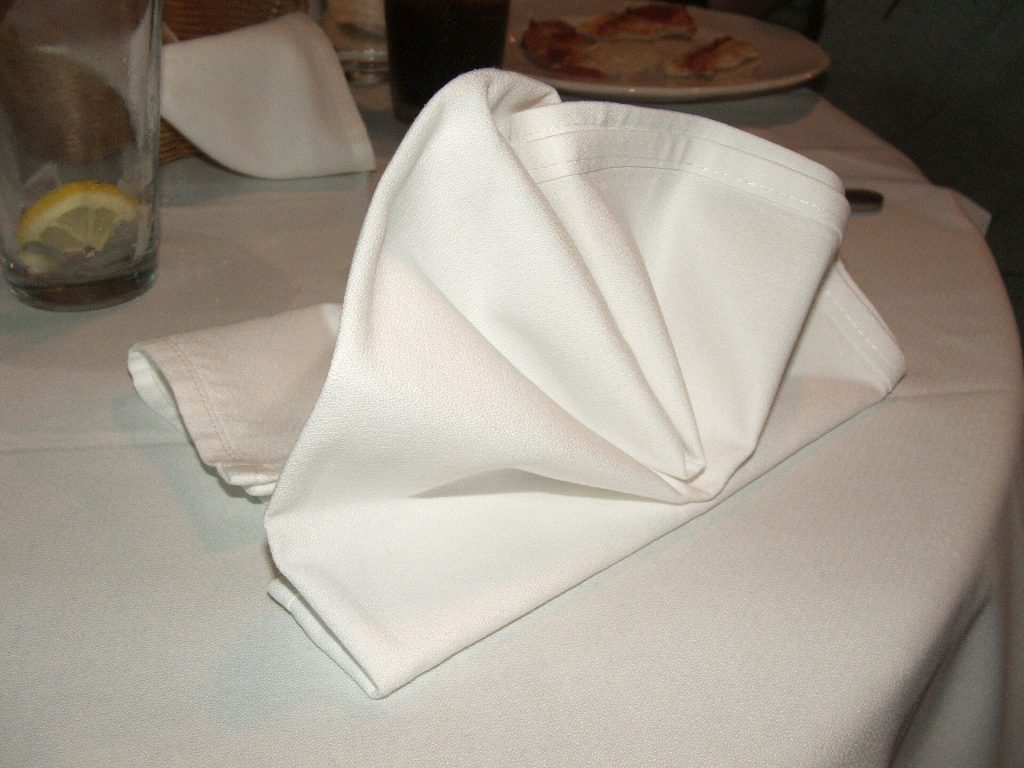
Featured photo: Folded napkin 01 by Tewy, BY 2.5.