Your restaurant labor cost percentage is total labor cost for a period divided by total sales for the same period, multiplied by 100. Spend $9,000 on labor in a week that brings in $30,000 and your labor cost is 30% of sales. The hard part isn’t the division. It’s putting the right costs on top of the fraction and looking at the number often enough to act on it.
Most operators check labor once a month, when the P&L lands, and by then the overspend is four weeks old. The owners who keep labor under control treat it as a weekly number, compare it with the schedule they wrote, and fix the gaps before the next one is posted.
This playbook walks through the formula, what to include, a worked example and the levers that pull the number down without leaving your floor short.
Key takeaways
- Labor cost percentage = total labor cost ÷ total sales × 100, using the same dates for both.
- Include wages, salaries, overtime, employer payroll taxes and benefits, not just hourly pay.
- Employer Social Security and Medicare alone add 7.65% on top of covered wages, per the IRS.
- Calculate it every week against forecast sales so you can adjust the next schedule, not the last one.
- Cut waste in the schedule before you cut people: shift start times, overtime and slow dayparts come first.
The formula, step by step
Run these steps at the end of each period. A week is the right period for most restaurants because it matches how you schedule.
- Pick the period. Use a fixed workweek, for example Monday to Sunday, and keep it the same every time.
- Total your sales. Use net sales from the POS for that period: food, beverage and any other revenue, after comps and discounts, before sales tax.
- Total your labor cost. Add every labor cost line for the same dates (the next section lists them).
- Divide labor by sales. Labor cost ÷ net sales gives you a decimal, such as 0.31.
- Multiply by 100. 0.31 becomes 31%. Log it next to the week’s date.
- Compare with your target. Set your target from your own P&L history and concept, then look at the gap, not just the number.
Two rules keep the number honest. Use the same dates for both halves of the fraction, and use the same definition of labor every week. Change either one and you can’t compare this month with last month.
What belongs in labor cost
A labor percentage built from hourly wages alone flatters you. The full cost of a person on the schedule is bigger than their rate.
Wages and salaries
- Hourly wages for front- and back-of-house staff.
- Salaried managers and chefs, spread evenly across the weeks they cover.
- Overtime premiums. Under federal law, covered employees earn at least time and a half for hours over 40 in a workweek, and the Department of Labor notes that hours can’t be averaged across two or more weeks.
- Training pay, meeting time and paid time off.
Employer payroll taxes
The IRS sets the employer share of Social Security at 6.2% and Medicare at 1.45%, so 7.65% of covered wages lands on top of the payroll you schedule. Social Security stops at the wage base, $184,500 for 2026, which few hourly restaurant roles reach. Add federal and state unemployment taxes and workers’ compensation premiums at the rates on your own filings.
Benefits
Health insurance contributions, retirement matches, staff meals you account for as a benefit, and any other employer-paid perks all count. If you pay them monthly, divide by the number of weeks so each week carries its share.
What to leave out, or track separately
Tips guests leave belong to your staff, not your P&L. If you use a tip credit, the federal rules for tipped employees require a direct cash wage of at least $2.13 an hour and a top-up if wages plus tips fall short of the $7.25 federal minimum; state rules may be higher. Count the wages you pay, including any top-ups, and keep contract services such as a cleaning company on a separate line so you can see them clearly.

A worked example
Say you run a 60-seat neighbourhood bistro. This is a hypothetical week, but the arithmetic is the same for any concept.
| Line | Amount |
|---|---|
| Net sales (POS, after comps, before tax) | $32,000 |
| Hourly wages incl. overtime | $6,900 |
| Salaried GM and chef (weekly share) | $2,300 |
| Employer Social Security and Medicare (7.65% of $9,200) | $704 |
| Unemployment tax and workers’ comp (from your filings) | $300 |
| Benefits (weekly share) | $450 |
| Total labor cost | $10,654 |
| Labor cost percentage | 33.3% |
Hourly wages alone would have shown 21.6%. Add salaries and it rises to 28.8%. The last 4.5 points are taxes and benefits that never appear on the schedule. That gap is why a manager who hits “their” labor number can still miss the owner’s.
Labor that isn’t on the schedule still lands on the P&L. Put every dollar in the fraction or the fraction lies.
Track it weekly, not monthly
Monthly labor tells you what happened. Weekly labor, compared with a forecast, tells you what to change.
- Forecast sales for next week from the same week last year and the last four weeks, adjusted for events and bookings.
- Write the schedule to the forecast. Convert the forecast into a labor budget in dollars, then build shifts to fit it.
- Check daily. Most POS and scheduling tools show labor against sales in real time. Look at it at the mid-shift and close.
- Close the week. Calculate actual labor cost percentage using the full definition above.
- Review the gap. Split it into three causes: sales came in under forecast, hours ran over schedule, or overtime appeared.
Track labor next to food cost in the same sheet. Together they are your prime cost, and our guide on restaurant food cost percentage shows how to calculate the other half.
Levers that lower it without hurting service
The goal is to spend labor where guests feel it and trim it where they don’t. Start with the items that cost money without improving service.
Tighten the edges of each shift
- Stagger start times so staff arrive as covers build, not all at once.
- Send the first cut home on schedule during slow shifts, using a clear order agreed in advance.
- Review clock-in and clock-out punches for early arrivals and late departures that nobody approved.
Manage overtime before it happens
- Check projected hours mid-week and rebalance shifts before anyone crosses 40.
- Cross-train so a short-staffed station doesn’t default to the same person picking up extra shifts.
Match labor to demand by daypart
- Pull sales by hour from your POS and compare with staff on the clock.
- Look hard at dead hours. Shortening opening hours or merging roles in a slow window can save more than trimming a busy shift.
Raise sales per labor hour
- Train servers on a few high-margin add-ons rather than scripts.
- Simplify prep with batch schedules so fewer hours go into the same output.
- Use your tech. A well-run kitchen display system or online ordering flow can let the same team handle more covers.
Keep an eye on turnover as you trim. Replacing a trained cook costs recruiting and training hours you’ll pay again, so a slightly higher labor line with a stable crew can beat a lower one that churns. More restaurant operations guides cover scheduling and retention in detail.
FAQ
What is the formula for labor cost percentage?
Divide total labor cost by total net sales for the same period and multiply by 100. For example, $9,000 of labor against $30,000 of sales is 30%.
Should I include payroll taxes and benefits?
Yes. Employer Social Security and Medicare add 7.65% of covered wages, and unemployment tax, workers’ comp and benefits sit on top. Leaving them out understates your true cost.
Do tips count as labor cost?
Tips guests pay to staff are not your labor cost. The cash wages you pay tipped workers, and any top-up to meet the minimum wage, are.
How often should I calculate it?
Weekly, against a forecast. Monthly figures are useful for the P&L, but they arrive too late to change a schedule.
Your first move this week
Pull last week’s POS net sales and payroll report, add taxes and benefits, and calculate your full restaurant labor cost percentage today. Then write next week’s schedule to a dollar budget, not a feel. After four weeks you’ll know which shifts drift, and you can fix those first.
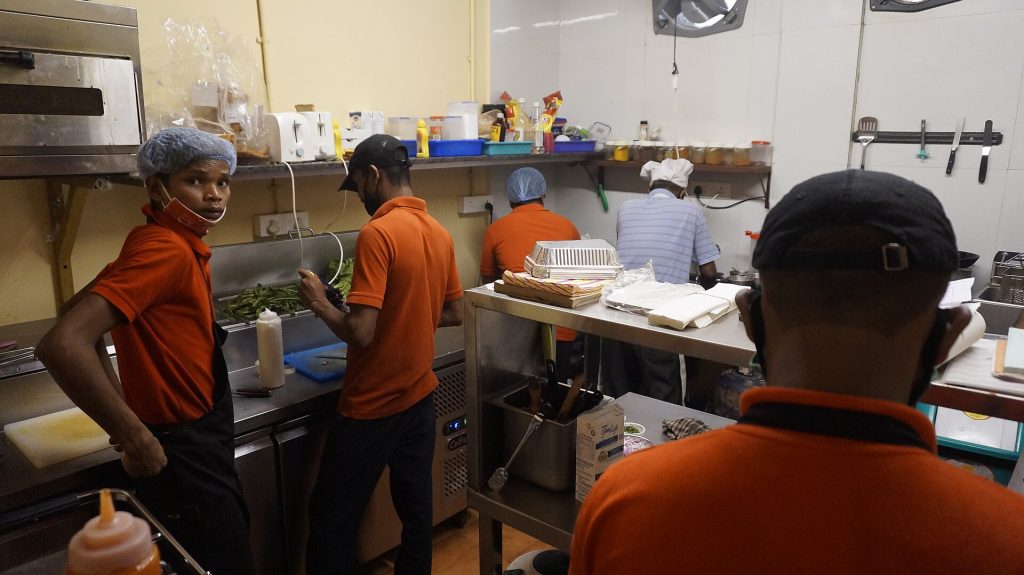
Featured photo: Staff in a kitchen restaurant, Goa by Fredericknoronha, BY-SA 4.0.