Adding brunch service to a dinner restaurant works best as a small, tested extension of what you already do, not a second restaurant. Test demand with a limited run, build the menu around ingredients you already stock, staff it with a lean crew, use pasteurized eggs for hollandaise and other pooled or lightly cooked egg dishes, and review the numbers after four weekends before you commit.
The appeal is obvious: your rent, equipment and dining room sit idle on weekend mornings. The risk is also obvious: a tired team, a new menu and a new set of food safety hazards.
To make it concrete, this walkthrough follows a hypothetical restaurant through each decision. The numbers are illustrations, not benchmarks; replace them with your own.
Key takeaways
- Run a limited trial before printing menus or hiring; measure covers, check average and labour.
- Build brunch dishes from dinner inventory to keep waste and ordering simple.
- FDA advises pasteurized eggs for pooled eggs and for hollandaise, béarnaise and similar sauces.
- The Food Code allows time as a public health control for up to 4 hours, with written procedures.
- Review four weekends of data, then decide whether to expand, adjust or stop.
Say you run a 60-seat bistro open for dinner Tuesday to Sunday. The kitchen has a six-burner range, a flat-top, a salamander and a combi oven. Your team is used to prepping from noon, and Saturday nights are busy. The owner wants to add weekend brunch.
Step 1: Test demand before you commit
Before changing anything permanent, the bistro runs a four-week pilot on Sundays only. It opens a limited number of seats for a two-and-a-half-hour window, offers a short menu and takes bookings through its existing system so demand is measurable.
- ☐ Announce it to your existing mailing list and social channels only; see who responds.
- ☐ Track bookings, walk-ins, covers per hour and table turn time.
- ☐ Record the check average and the share of guests who order a drink.
- ☐ Ask guests directly whether they would come on Saturdays too.
- ☐ Log labour hours and every item thrown away at close.
If the pilot cannot fill a fraction of the room, a bigger launch will not fix that. If it sells out, you have evidence to expand.
Step 2: Build the menu from what you already stock
Menu engineering is the practice of analysing each dish by both popularity and profit, then promoting the winners and reworking or dropping the rest. For brunch, the first rule is simpler: use what is already in the walk-in.
| Dinner ingredient | Brunch use | Why it works |
|---|---|---|
| Braised short rib | Short rib hash with fried egg | Uses trim and end portions |
| House focaccia or brioche | French toast, toast plates | Day-old bread becomes a feature |
| Smoked salmon starter | Salmon on toast with pickled onion | Same prep, new plate |
| Seasonal greens | Side salad with every savoury plate | Balances rich dishes |
| Roast potatoes | Crispy breakfast potatoes | Same prep, higher volume |
New purchases should be few: eggs, breakfast pork, a pastry item and fruit. Keep the menu to around eight or ten dishes during the pilot. A short menu is faster to cook, easier to cost and easier to change. Our guide to menu engineering walks through the popularity and profit analysis.
Step 3: Staff the shift
The danger is asking a Saturday night crew to come back at 8 a.m. on Sunday. Burnout will show up in both services.
- Kitchen: one cook on eggs and the flat-top, one on hot plates and the salamander, and a prep or dish cook. Consider staff who want morning shifts rather than dinner regulars.
- Front of house: one manager, servers scaled to bookings, and a bartender or a server who handles drinks.
- Prep: hollandaise, hash, batters and fruit prepped at the start of the shift with clear par levels.
- Scheduling: keep brunch staff off the late Saturday close wherever possible.
Step 4: Get egg safety right
Brunch introduces egg-heavy dishes most dinner kitchens rarely make in volume. This is the part of the plan to write down before the first service.
Pooled eggs and sauces
FDA’s guidance for retail and foodservice says that, as a general rule, pasteurized eggs or egg products should be used in any recipe that combines more than one egg, known as pooling. It also advises substituting pasteurized eggs or egg products for raw shell eggs in foods such as Caesar salad, hollandaise or béarnaise sauce, mayonnaise, eggnog, ice cream and egg-fortified beverages.
The FDA Food Code sets a cooking standard for raw eggs broken to order for immediate service of 145°F for 15 seconds, and 155°F for 17 seconds for eggs not prepared for immediate service. It requires cold holding at 41°F or below and hot holding at 135°F or above. FDA’s consumer egg safety advice adds that casseroles and other dishes containing eggs should be cooked to 160°F, which is a sensible target for a baked strata or frittata.
Holding hollandaise
A warm emulsified sauce does not sit comfortably at either holding temperature. Section 3-501.19 of the Food Code allows time as a public health control instead: food can be held without temperature control for up to 4 hours if it is marked with the discard time, thrown out when that time passes, and covered by written procedures available to your inspector. Check whether your jurisdiction permits this and has its own requirements.
- ☐ Buy pasteurized eggs or egg products for hollandaise, pooled scrambles and batters.
- ☐ Make hollandaise in small batches and label each with its discard time.
- ☐ Keep shell eggs refrigerated until they are cracked.
- ☐ Wash hands before and after handling raw eggs, as FDA advises.
- ☐ Add a consumer advisory if you serve undercooked eggs, such as runny yolks.
Brunch is where a dinner kitchen suddenly becomes an egg kitchen. Plan for that before the first ticket prints.
Step 5: Plan the beverage program
Drinks can carry the economics of brunch. The bistro builds a compact list from what the bar already stocks: a sparkling wine that works in cocktails, a juice-based cocktail, a savoury tomato cocktail, a non-alcoholic spritz, and good coffee and tea.
- Check that your licence allows alcohol service at the hours you plan to open.
- Batch juices and cocktail mixers before service to keep the bar fast.
- Offer at least two considered non-alcoholic drinks alongside coffee.
- Treat coffee as a real product: fresh beans, clean equipment and a trained person on the machine.
Step 6: Price it and review the first month
Price each dish from its plate cost, and set the menu so that the likely check average covers the extra labour and utilities of opening early. Suppose the bistro’s pilot shows an average of one drink per guest; the drink list then matters as much as the food prices.
The first-month review
After four Sundays, the owner reviews the numbers against the dinner trade.
- Covers: did bookings grow, hold or fade week to week?
- Check average: food and drink separately.
- Labour: hours and cost against brunch sales.
- Waste: what was thrown out, and which dishes caused it?
- Dinner impact: did Saturday or Sunday dinner service suffer?
- Team: ask staff what broke and what they would change.
The decision then is to expand to Saturdays, adjust the menu and hours, or stop. Any of the three is a good result if the numbers support it.
FAQ
Do I need pasteurized eggs for hollandaise?
FDA advises substituting pasteurized eggs or egg products for raw shell eggs in hollandaise and béarnaise, and when pooling eggs.
How long can hollandaise sit out?
Under the Food Code’s time as a public health control, up to 4 hours with marking and written procedures, if your jurisdiction allows it.
Should brunch run on Saturday and Sunday from day one?
It is safer to pilot one day first, measure demand, and expand only if the numbers support it.
How big should a brunch menu be?
Small enough to cook quickly and cost accurately. Eight to ten dishes is a sensible starting point for a pilot.
Sketch your own brunch plan
List every ingredient in your walk-in and write one brunch dish beside the ones that could carry it. Add egg safety procedures, a staff plan and a four-week review date, then set your pilot. For more ideas, browse our food and dining guides, see how other restaurants handle weekends in our restaurant directory, and read our tips on keeping food costs in check.
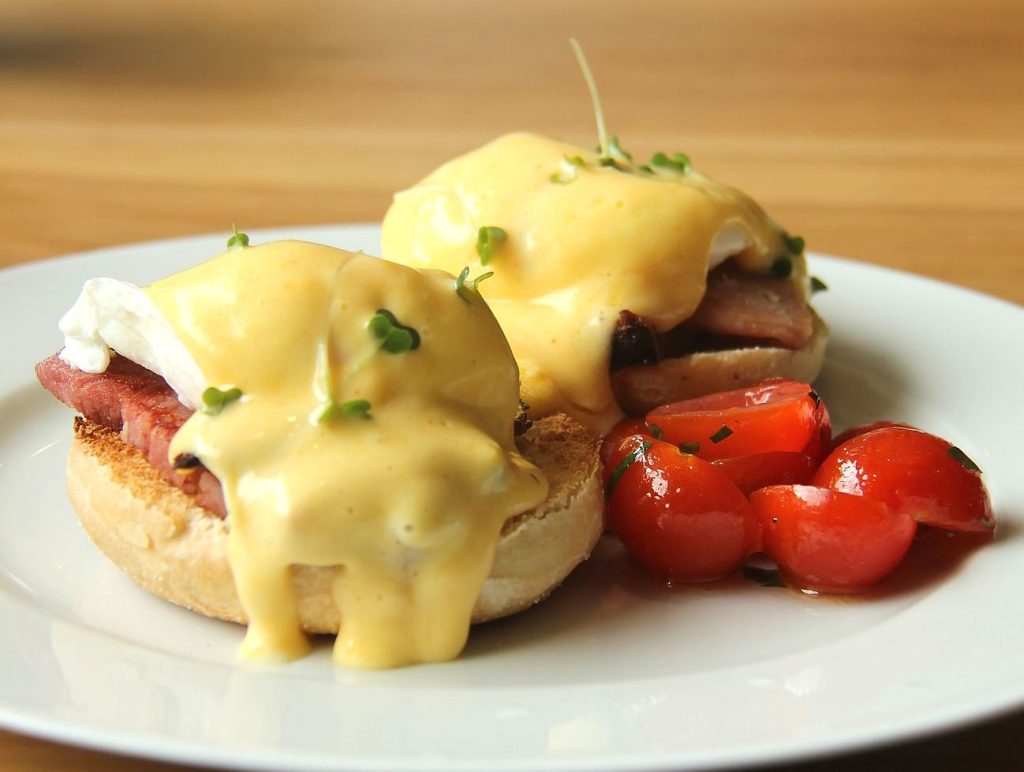
Featured photo: Eggs Benedict-01-cropped by Jon Mountjoy, BY 2.0.