The right restaurant plateware is the one that survives your dish pit, fits your portions and suits your price point. For most full-service rooms that means a commercial-grade porcelain; stoneware suits rustic concepts; bone china suits fine dining that can afford it; and melamine suits patios, buffets and high-breakage settings where it will never go in a microwave.
Plates are a recurring cost, not a one-off purchase. Breakage, chips and pieces that walk out of the building all add up, and a plate that is the wrong size quietly changes how generous every portion looks.
This guide covers the criteria that matter: material, durability, shape, sizing, heat and dishwasher compatibility, par levels and budget tiers. It does not rank brands, because the right supplier depends on your market and volume.
Key takeaways
- Porcelain and stoneware are both vitrified, meaning glasslike and impervious to liquid.
- Bone china contains bone ash, is ivory-white and, according to Britannica, does not chip easily.
- FDA says food can be served on melamine but should not be heated on it in a microwave.
- Under the Food Code, food-contact surfaces must be free of chips and cracks, so damaged plates must come out of service.
- Size plates to the portion and plating style, and set par levels from your covers, turns and dish-machine cycle.
The four materials compared
Four materials cover nearly every commercial dining room. Each has a clear role.
| Material | What it is | Strengths | Watch-outs | Typical fit |
|---|---|---|---|---|
| Porcelain | Vitrified, white, fine-grained body, usually translucent | Non-porous, clean white canvas, wide commercial range | Quality varies widely between lines | Most full-service restaurants |
| Stoneware | Pottery fired at about 1,200°C until vitrified | Non-porous, earthy look, reactive glazes | Heavier; glaze finish varies piece to piece | Rustic, casual and farm-to-table concepts |
| Bone china | Hybrid hard-paste porcelain containing bone ash | Ivory-white, fine and light, does not chip easily | Highest cost | Fine dining, afternoon tea, hotel service |
| Melamine | Plastic tableware | Light, hard to break | Not for microwave heating; can scratch | Patios, pools, buffets, kids’ menus |
The definitions come from Britannica’s entries on porcelain, stoneware and bone china. Porcelain is described as vitrified pottery with a white, fine-grained body, as distinguished from porous, opaque earthenware. Stoneware is fired at about 1,200°C, or 2,200°F, which vitrifies it so it is glasslike and impervious to liquid.
Bone china was introduced by Josiah Spode the Second around 1800, and Britannica gives the standard body as six parts bone ash, four parts china stone and three and a half parts china clay. It is most popular for table services in England and the United States.
Durability and chip resistance
Chips are more than a cosmetic problem. Section 4-202.11 of the Food Code, shown here as adopted in Delaware’s code, requires multiuse food-contact surfaces to be smooth and free of breaks, cracks, chips, pits and similar imperfections. A chipped plate is a plate that must be pulled.
What to look for
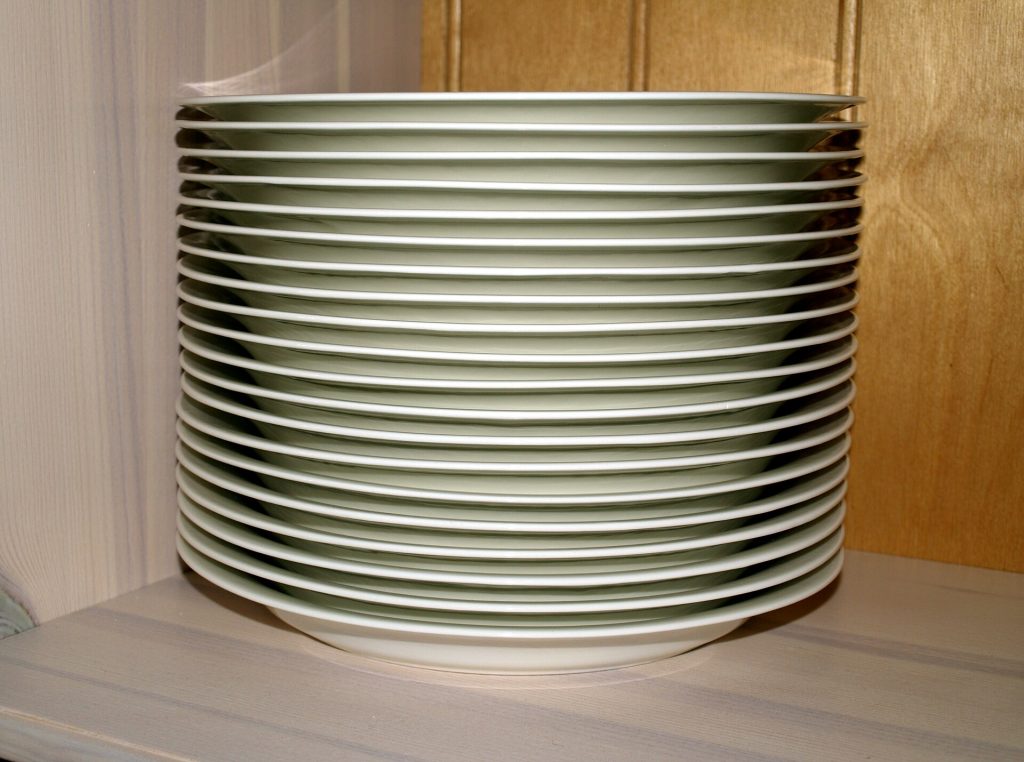
- Rolled or reinforced edges. The rim takes most knocks in a dish pit, so a thicker, rounded edge lasts longer than a knife-thin one.
- A fully vitrified body. Ask the supplier to confirm it; a non-porous body will not absorb water or stains through a chip.
- A glazed foot, or at least a smooth one. A rough foot scratches stacked plates and marks tables.
- Stackability. Plates that nest securely are knocked less when staff carry and rack them.
- A chip warranty. Many commercial lines offer one; read the terms before comparing prices.
Bone china earns its place partly here: Britannica notes that it does not chip easily, which offsets some of its price in a busy room. Melamine is the most breakage-resistant option but scratches over time, which affects how it looks under bright light.
A cheap plate that chips in six months is the expensive plate.
Rim, coupe and sizing to your portions
Rim or coupe
A rimmed plate has a flat border around the well. It frames food, gives servers a clean place to hold it and hides a lighter portion inside a wider diameter. A coupe plate has no rim and curves up gently to the edge, so the full surface is usable. Coupes suit shared plates, casual service and modern plating; rims suit classic presentations and dishes with sauce that needs a wall.
Size the plate to the portion
Start with the dish, not the catalogue. Plate each menu item on a few sizes and photograph them from the guest’s seat. An undersized plate looks crowded and invites spills on the carry; an oversized plate makes a correct portion look stingy.
- List every menu item and its standard portion.
- Group items that can share one plate size and shape.
- Test-plate the largest and smallest item in each group.
- Check that each size fits your pass, heat lamp shelf, tray and dish-machine rack.
- Cut the range down to as few sizes as you can; fewer SKUs means simpler par levels.
For more on consistent portions, our guide to portion control pairs well with this step.
Heat, dishwashers and the pass
Plates go through the dish machine many times a day and sit under heat lamps at the pass. Ask for written confirmation that a line is rated for commercial dishwashers and whatever heat your kitchen uses, including ovens, salamanders or heat lamps if you finish or hold food on the plate.
- Melamine: FDA’s melamine tableware Q&A says food and drinks may be served on plastic tableware, but should not be heated on melamine-based dinnerware in microwave ovens. Keep it out of any heating role unless the manufacturer rates it for that use.
- Metallic trims and decals: check whether they are rated for commercial dishwashing and for microwave use before you buy.
- Rack fit: confirm large plates and deep bowls fit your dish-machine racks without angling.
- Thermal shock: ask the supplier how the line handles moving from a hot plate warmer to cold water.
Par levels and budget tiers
Setting par levels
A par level is the number of each item you need on hand for your busiest service, plus a buffer. Work it out from your own numbers. Say you run a 60-seat bistro that turns the room twice on a Saturday and serves an average of one entree plate per guest. That is about 120 entree plates in a night, but because plates cycle back through the dish machine, you need enough to cover the peak hour plus plates in the machine, on the pass and waiting to be bussed.
- Count how many of each plate are in use at your busiest 30 minutes.
- Add the plates sitting in the dish pit and on the pass at that moment.
- Add a buffer for breakage, chips pulled from service and slow dish nights.
- Recount monthly and log the losses, so you know your real replacement rate.
Budget tiers
| Tier | Materials | Best for | Trade-off |
|---|---|---|---|
| Entry | Melamine, basic commercial porcelain | Patios, quick service, high breakage | Shorter life, fewer shapes |
| Mid | Fully vitrified commercial porcelain with reinforced edges, stoneware | Most full-service restaurants | Good balance of cost and life |
| Premium | Bone china, designer porcelain or handmade stoneware | Fine dining, signature presentations | Higher replacement cost per piece |
Keep your core plates in a line that will stay in production so you can reorder matching pieces, and use a smaller number of statement pieces for signature dishes.
FAQ
What is the most durable restaurant plateware?
Melamine is the hardest to break, but it cannot be heated in a microwave and scratches over time. Among ceramics, fully vitrified porcelain with reinforced edges and bone china, which Britannica notes does not chip easily, hold up best.
Is stoneware good for restaurants?
Yes, when it is fully vitrified and rated for commercial dishwashers. It suits rustic concepts, though it is usually heavier than porcelain.
Do chipped plates have to be thrown away?
They have to come out of food service. The Food Code requires food-contact surfaces to be free of chips and cracks.
Rim or coupe plates?
Rims frame classic plating and make portions look generous; coupes give more usable surface for sharing and modern presentations.
Run a plate trial before you buy
Before you place a big order, ask two or three suppliers for samples of the pieces you shortlisted. Run them through your dish machine for two weeks, plate your menu on them and let servers carry them on a busy night. Count chips and scratches, then buy the line that survived. For more front-of-house ideas, see our food and dining guides, browse the restaurant directory to see how other rooms present their food, and read our guide to table setting.
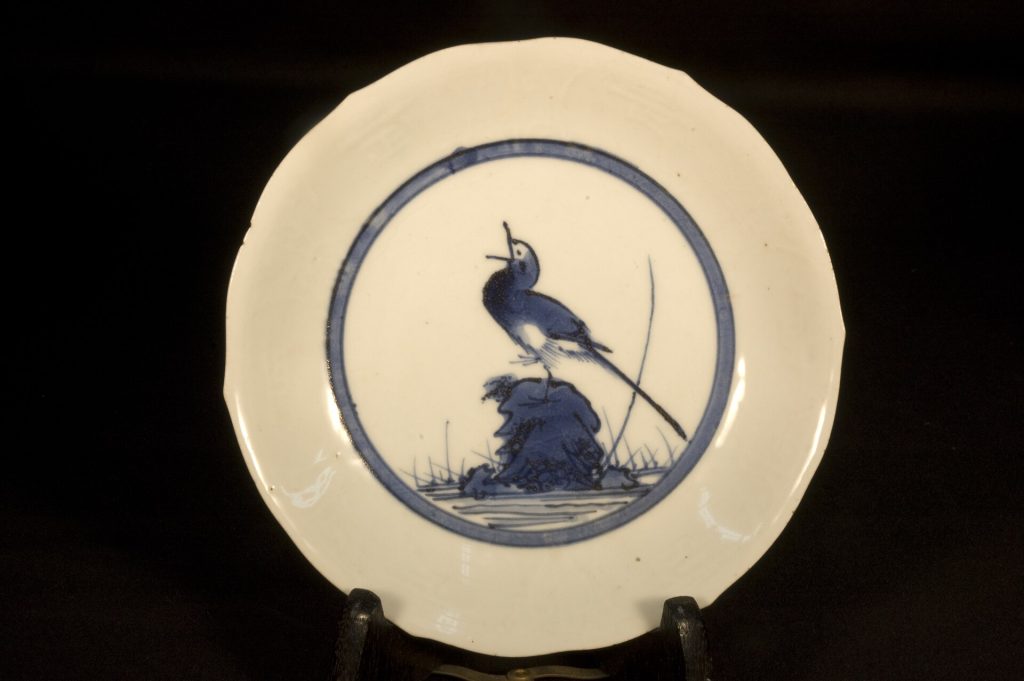
Featured photo: Blue and white porcelain plate with a blue under-glaze of a wagtail perched on a rock – Vanderbilt Fine Arts Gallery – 1978.011 by Vanderbilt University, CC0.