There is no honest single answer to how often to change fryer oil. A fryer doing chips all day in clean oil can run far longer than one frying breaded fish at high heat. The right rule is to change it when tests and clear sensory signs say it is spent, and to use daily filtering and good habits to push that point further out.
That sounds vague, but it is more precise than a fixed calendar. A calendar either throws away good oil or keeps serving bad food. A simple testing routine tells you exactly where you stand, shift by shift.
This guide walks through the steps: set a baseline, fry at the right temperature, filter, test, spot the warning signs and dispose of the old oil without landing a sewer fine.
Key takeaways
- Change oil based on its condition, not the day of the week. Test it and log the result.
- The USDA says to discard oil that is cloudy, foams, or has a foul odour or taste.
- Several European countries set a regulatory limit of 25–27% total polar compounds. The US has none, but the measure is a useful house standard.
- Filtering and skimming crumbs daily is the cheapest way to extend oil life.
- Never pour used oil down a drain. Store it covered and send it to a recycler.
In this guide
- What wears out fryer oil
- Step-by-step routine
- How to test fryer oil
- Signs oil is spent
- Daily and weekly routine
- Safe disposal
- FAQ
What actually wears out fryer oil
Hot oil breaks down through oxidation, polymerisation and hydrolysis, often all at once. A technical article from the American Oil Chemists’ Society lists the main drivers: high frying temperatures, long frying times and repeated cycles, exposure to air, moisture and steam, the type of food being fried, and the design of the fryer itself.
In kitchen terms, that means four things shorten oil life fastest:
- Heat. Idling at full temperature between rushes does damage without cooking anything.
- Water. Wet or frozen product with ice crystals releases steam into the oil.
- Debris. Breading and crumbs that sit on the bottom burn and darken the whole vat.
- Air. An uncovered fryer after close keeps exposing warm oil to oxygen.
Control those four and you control the replacement schedule.
How to extend and change fryer oil, step by step
- Start with a baseline. Fill with fresh oil, write the date and time on the fryer log, and note the first reading from your test strip or meter. Every later reading is compared against this one.
- Fry at the temperature the product needs. The USDA’s deep-fat frying guidance gives 375°F for chicken pieces, 350°F for chicken fingers and 320°F for fish fillets and shrimp. There is no benefit to running hotter than the food needs. Drop the fryer to a lower standby setting in quiet periods if your model allows it.
- Shake off ice and excess breading. Tap baskets over the prep table, not over the oil, and drain frozen product of loose ice before it goes in.
- Skim throughout service. Pull floating crumbs with a fine skimmer every few batches so they do not sink and burn.
- Filter at least once a day. Use the built-in filtration system or a portable filter machine at the end of service, following the manufacturer’s instructions for oil temperature and filter media. Busy fryers often benefit from a mid-day filter as well.
- Top off with fresh oil. Food absorbs oil, so the level drops. Topping up keeps the correct level for even cooking and dilutes some of the breakdown products.
- Test and log. Take a reading at the same point each day, usually before the first service. Record it next to the date.
- Cover the fryer when it is off. A lid limits contact with air and keeps dust and debris out overnight.
- Change when the test or the signs say so. Drain, clean the vat and elements according to the manufacturer’s instructions, dry it completely, then refill and start a new baseline.
A fixed calendar either throws away good oil or keeps serving bad food. A test tells you which.
How to test fryer oil
Total polar compounds
As oil breaks down it builds up what chemists call total polar compounds, or TPC. The AOCS article notes that TPC is accepted in Europe as a standard reference measure for frying oil quality, and that several European countries have regulatory limits of 25–27% TPC for deteriorated oil. It also notes that no such regulation exists in the United States.
You do not need a lab. Handheld TPC meters and disposable test strips are sold for commercial kitchens. Pick one discard point, write it on the fryer log, and use it consistently. Many operators set their own trigger a little below the European limits so the change happens before quality visibly slips.
Sensory checks
Even with a meter, train every fry cook to recognise spent oil. These checks are free and take seconds.
Signs your fryer oil is spent
The USDA is blunt: discard oil if it is clouded, if it starts to foam, or if it has a foul odour, taste or smell. The AOCS article adds increased viscosity, colour change and foam development to the observable signs of breakdown. On the line, that looks like this:
- Foam that builds up and does not settle when a basket goes in.
- Oil that looks cloudy or murky rather than clear.
- An acrid, fishy or rancid smell over the fryer.
- Oil that feels thick and gummy on the skimmer and sticks to baskets.
- Smoke at your normal cooking temperature.
- Food that browns too quickly on the outside, stays pale inside, or comes out greasy.
- Off-flavours that turn up in plain product like fries.
If two or more show up at once, change the oil, even if the calendar says it is early. The cost of a vat of oil is small next to a table sending back soggy, bitter food.

A daily and weekly fryer routine
| Task | When | Why it matters |
|---|---|---|
| Skim crumbs | Every few batches | Stops debris burning and darkening the oil |
| Check oil level and top off | Before each service | Keeps cooking even and dilutes breakdown products |
| Test oil and log the reading | Daily, same time | Shows the trend so you change oil at the right point |
| Filter | At least daily, more on busy fryers | Removes fine particles that speed breakdown |
| Cover fryer | Whenever it is off | Reduces exposure to air and debris |
| Boil-out or deep clean | Per manufacturer, usually at oil change | Removes carbon and polymer build-up from the vat |
| Check oil collection container | Weekly | Makes sure it is covered and not leaking |
Put the routine on a laminated card by the fryers and make one person per shift responsible for the log. For more on keeping the rest of your line running, see our commercial fryer maintenance notes.
How to dispose of used fryer oil safely
Used oil is not a drain problem you can rinse away. The USDA says plainly: do not pour oil down the sink. In a commercial kitchen the rules usually come from your local sewer authority. Portland’s fats, oil and grease best management practices are a typical example:
- Recycle waste cooking oil, and never pour it down a sink or drain.
- Cover outdoor grease storage containers so they do not collect rainwater.
- Keep grease containers and dumpsters away from storm drains and catch basins.
- Use absorbent pads to clean up spills around outdoor equipment.
- Dry-wipe pots and pans into the bin before washing, to reduce grease heading to the trap.
Portland notes that waste oil recyclers in Oregon compensate businesses for used oil, which lowers disposal costs. Ask your local renderer or recycler what they offer. Always let oil cool before draining, and use the container your hauler supplies. The same habits keep your grease trap from filling up faster than it should.
Fryer oil questions from the line
Can I use the same oil for fish and fries?
You can, but flavours carry over and fish tends to break oil down faster. Where you have more than one fryer, dedicate one to seafood and one to potatoes and other neutral items.
Does topping off replace changing the oil?
No. Topping off keeps the level right and slows the decline, but it does not remove the breakdown products already in the vat. When tests or signs say the oil is spent, change it completely.
Is there a legal limit for fryer oil in the US or Canada?
The AOCS article states that the United States has no TPC regulation. Your local health inspector can still act on poor sanitation, and your local sewer authority regulates how you dispose of grease. Set your own written standard and stick to it.
How should I store oil I plan to reuse?
The USDA recommends straining used oil and storing it in a sealed, light-proof container. In a commercial fryer the practical equivalent is filtering daily and keeping the vat covered when it is off.
Put it into practice tomorrow
Buy a pack of test strips or a TPC meter, set a written discard point, and start a fryer log tomorrow morning. After two or three oil changes you will see how many days each fryer really lasts, and you can plan orders around facts instead of guesses. For more on hygiene routines, browse our food safety guides.
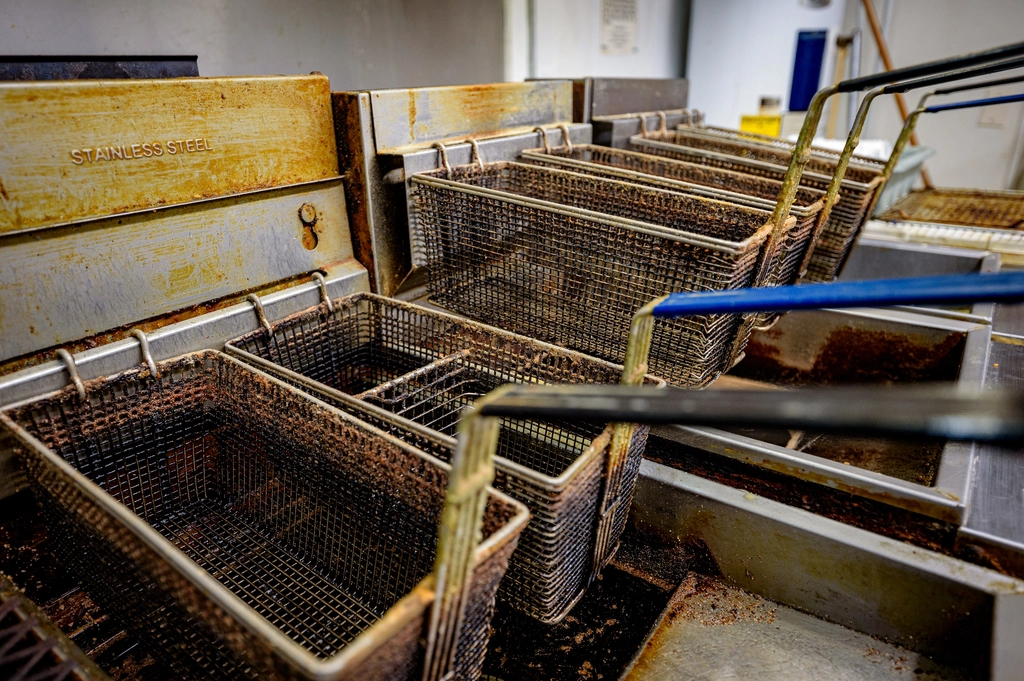
Featured photo: Industrial kitchen deep fryers equipment by unknown, CC0 1.0.